

A Comprehensive Guide to Microfiber Car-Drying Towels: From Fiber Structure to Selection and Usage
Drying a vehicle after a wash may seem simple, but it is actually one of the steps most likely to damage the paintwork. Ordinary towels have coarse fibers and poor absorbency; as you drag them across the surface, any trapped grit acts like sandpaper, leaving behind “swirl marks” (or “spider webbing”) on the clear coat. Microfiber towels have become the industry standard in professional car detailing precisely because their fine fibers can “hide” particulate matter, while utilizing capillary action to draw away water—rather than relying on brute-force wiping. However, simply buying any cloth labeled “microfiber” does not guarantee safety. Factors such as fiber composition, fabric weight (GSM), weave pattern, and edge-finishing techniques all determine whether the towel protects your paint or quietly damages it.
I. Why Microfiber Doesn’t Damage Paint
The “fineness” of microfiber represents a significant leap in physical properties. While a standard cotton fiber is a fraction of the thickness of a human hair, a processed (split) microfiber filament can be several hundred times thinner. This extreme fineness ensures that the fiber tips are exceptionally soft, preventing rigid, abrasive contact as they glide over the paint. Furthermore, the splitting process divides each filament into multiple strands, exponentially increasing the surface area and creating a network of tiny pores. This allows water to be “drawn in” via capillary action, rather than merely pushed around the surface.
More importantly, there is the mechanism of decontamination. The cross-sectional structure of microfiber allows it to capture dust particles as small as a few microns, encapsulating grit within the fiber clusters instead of pushing it to roll across the paint surface. This is why, when both are used on a dusty surface, a cotton towel might leave fine scratches, whereas a high-quality microfiber towel remains relatively safe—provided, of course, that the towel itself is clean and the paint surface is free of large, abrasive debris. II. Understanding Two Key Parameters: Blend Ratio and GSM
Microfiber car-drying towels are typically labeled with a blend ratio of polyester and polyamide (nylon). A 70/30 ratio is widely considered the “gold standard,” offering an optimal balance between water absorption and durability; it is safer and less likely to scratch the vehicle’s paintwork compared to the more common 80/20 blend. Polyamide provides water absorption, while polyester contributes strength and structural integrity—a lower proportion of polyamide results in reduced absorbency. Some budget-friendly products may incorporate acrylic fibers to cut costs, which significantly impairs water absorption and greatly increases the likelihood of leaving water streaks behind.
GSM (grams per square meter) determines the towel’s thickness and water-holding capacity. For routine drying, a GSM of 400–600 is sufficient. Professional-grade drying towels often range from 900–1200 GSM or higher; a large towel of this caliber can absorb the water from an entire vehicle in one pass, minimizing the need for repeated wringing or excessive wiping. However, a higher GSM is not always better: excessively thick towels are difficult to wring out, take longer to dry, and—if not aired properly—can easily develop unpleasant odors.
III. Choosing the Right Towel for the Right Task
Professional car detailing never relies on a “single towel for the whole car.” At a minimum, you should use separate towels for the following three purposes:
Drying Towels: These are the largest and heaviest (highest GSM) towels, typically featuring a twisted-loop or short-pile weave. The twisted-loop structure creates spiral-shaped fibers that absorb water rapidly, allowing you to remove moisture simply by laying the towel down and pulling it across the paint surface. Short-pile weaves are less likely to snag on emblems or the edges of trim pieces, making them safer for use around complex vehicle contours.
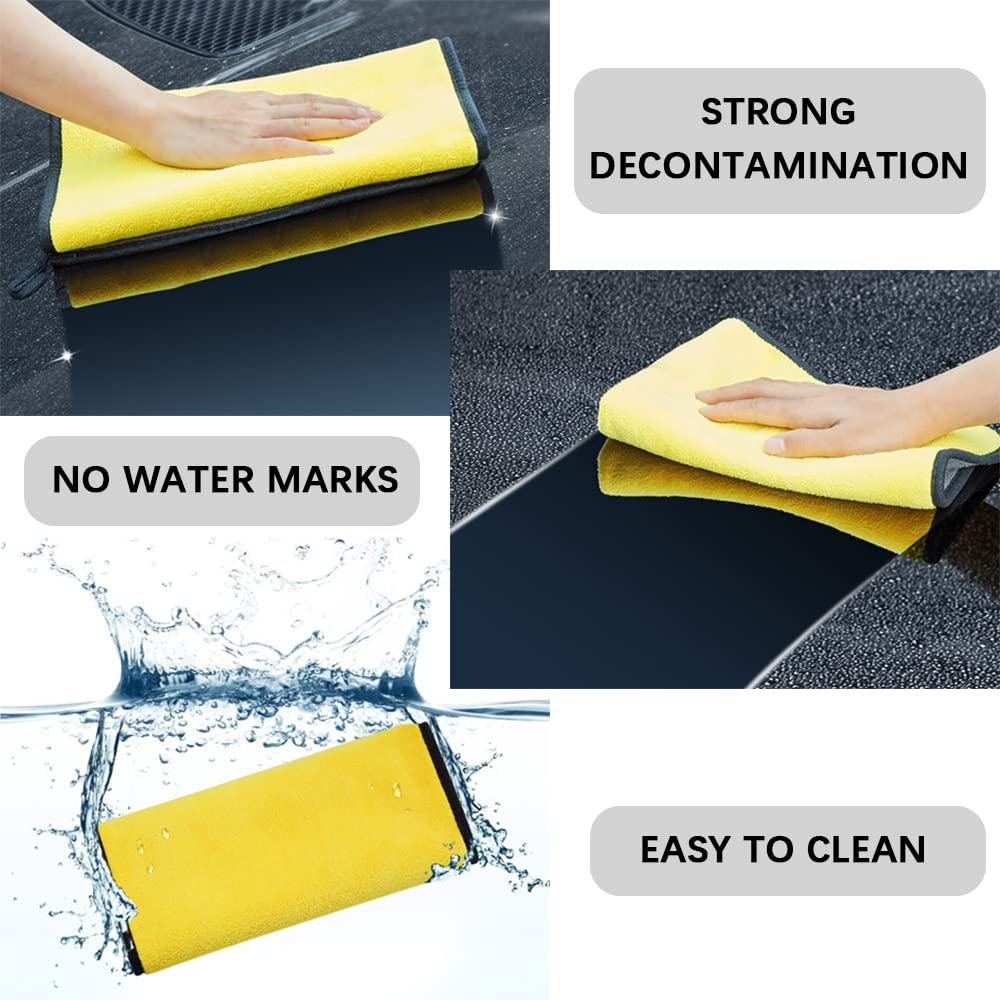
Detailing/Interior Towels: These are medium-sized towels with short fibers or a flat weave, designed for use on door jambs, wheels, dashboards, and screens. While these tasks do not require extreme water absorption, the towels must be lint-free and shed-resistant. A short-pile towel with a 70/30 blend ratio is a versatile, all-purpose choice. Glass-cleaning towels: These feature the tightest weave, often with a waffle-like texture. They leave no lint behind on glass surfaces and, when used with a glass cleaner, help minimize water spots.
IV. Edging and Tags: Often-Overlooked Sources of Paint Damage
Even the highest-quality microfiber can become a hazard if it features rigid stitching or coarse edging; when wiping curved surfaces, such an edge can act like a blade, scratching the paint. Premium car-care towels typically use soft, suede-like edging or a laser-cut, edgeless design, ensuring the edge is flush with the towel’s surface to eliminate any hard boundaries. Furthermore, a tagless design is equally important—a care label sewn into a corner can leave fine scratches when drying the vehicle. Professional-grade products often feature removable tags or information printed directly onto the fabric.
V. The Wrong Technique Renders Even the Best Towel Useless
Purchasing the right towel is only the first step. Proper usage and maintenance determine how long a towel can remain safe to use on your vehicle.
Rinse away dirt first. If there are large particles of grit or mud on the car, any towel used will essentially act as an abrasive. Always use a pressure washer or hose to rinse away loose debris before letting a towel touch the paint.
Use a “lay-and-drag” technique for drying, not a circular motion. Lay the drying towel flat on the surface and gently pull it across, allowing the fibers to absorb the water naturally. Wiping in circular motions only increases unnecessary friction and offers no benefit.
Avoid fabric softeners during washing. Softeners create a film over the fibers, clogging their microscopic pores and quickly ruining the towel’s absorbency. Use a neutral-pH laundry detergent or a dedicated microfiber cleaner; wash separately—either by hand or in a machine—using cold or warm water. Air-dry or tumble-dry on a low-heat setting; never expose the towels to direct, intense sunlight.
Implement color-coding. Use different colored towels for the car body, glass, interior, and wheels to prevent cross-contamination. A towel that has been used on wheels or the lower rocker panels may harbor metallic particles or grit—never use such a towel on the vehicle’s paintwork again. VI. What Is the Lifespan of a Quality Towel?
Microfiber possesses significantly greater strength than cotton. Under normal conditions of use and maintenance, a high-quality car-detailing towel can withstand hundreds of washes without any noticeable loss in performance. However, it is time for a replacement if you notice any of the following signs: the fibers have become noticeably stiff, the water-absorption rate has dropped significantly (water no longer spreads and absorbs quickly upon contact), or the stitched edges have begun to fray or detach. Once the fibers harden and lose their softness, continuing to use the towel increases the risk of damaging the vehicle’s paintwork.
Ultimately, the value of a microfiber detailing towel does not lie in a sense of “luxury,” but in its ability—leveraging the precision of materials science—to solve a specific problem: removing water from the surface without turning the impurities contained within that water into scratches on the paint. By choosing the right material composition and fabric weight, and by employing proper usage techniques, a towel costing just a few dozen yuan can last for well over half a year—a far more cost-effective solution than repeatedly undergoing paint polishing to remove swirl marks.
Post time: Nov-04-2026