

A Comprehensive Guide to Microfiber Car-Drying Towels: From Fiber Technology to Paintwork Safety
When it comes to washing a car, the most overlooked step isn’t applying foam or rinsing—it’s the final drying process. Many car owners are happy to spend hundreds on premium car wash soap, yet they’ll grab any old towel to dry their vehicle, only to end up with a dense web of “swirl marks” visible under direct sunlight. Microfiber towels have become the industry standard in professional auto detailing, rooted in material science—specifically regarding fiber fineness, weave structure, and capillary action. This article avoids a simple list of product recommendations; instead, it provides an in-depth look at these towels, helping you develop your own criteria for choosing the right one.
I. Why Microfiber Ensures Paintwork Safety
The problem with using ordinary cotton towels on a car is that the fibers are too coarse. Cotton fibers typically have a diameter of 15–20 microns; while they may feel soft to the naked eye, at the microscopic level of a car’s clear coat, they act like tiny mops—dragging grit and dust particles across the paint surface. In contrast, microfiber strands can be as fine as 1/200th the thickness of a human hair, reaching the micron or even sub-micron scale. This means that for any given area, microfiber provides dozens of times more surface area than conventional fibers. Through a “wedge-shaped” splitting technique (often referred to as a “segmented” or “orange-slice” structure), these fibers trap water molecules and dust particles within their microscopic pores, preventing them from sliding across and scratching the paint.
Equally important is the material composition. Most microfiber towels on the market are a blend of polyester and polyamide (nylon), typically in an 80/20 or 70/30 ratio. Polyester provides structural integrity and wear resistance, while polyamide contributes to water absorption and softness. A 70/30 blend is generally considered the higher-end choice; a greater proportion of polyamide results in a finer, softer feel and superior moisture absorption—a ratio frequently used in the mid-to-high-end product lines of professional auto detailing brands. However, the composition ratio is not the only indicator; the weave and the GSM (grams per square meter) also determine how a towel performs in practice.
II. GSM and Weave: Don’t Be Misled by the “Thicker Is Better” Myth
GSM (grams per square meter) is the most straightforward metric when shopping for towels, yet it is frequently misunderstood. While a 600 GSM towel is indeed thicker and more absorbent than a 300 GSM version, that doesn’t mean it’s the right choice for every task.
For drying a vehicle, you need a large, high-GSM towel. Since a significant amount of water remains on the car body after rinsing, a drying towel measuring 60×90 cm with a density of 450–600 GSM allows you to remove large sheets of water in a single “lay-and-drag” motion. This minimizes the need for repeated wiping, thereby reducing the risk of creating scratches. Conversely, for tasks like cleaning paintwork, wiping down interiors, or removing wax/polish residue, a medium-density towel—typically 300–400 GSM and sized between 30×30 cm and 40×40 cm—is a better choice. Towels that are too thick or plush can feel cumbersome in these delicate applications and are harder to maneuver around tight corners or edges.
Another often-overlooked detail is the distinction between long-pile and short-pile weaves. Long-pile (plush) towels have a fluffy surface where the fiber tips can “flick away” larger dust particles, making them ideal for drying or dusting. Short-pile or flat-weave towels, which have a finer, more uniform surface, are better suited for removing wax/polish or cleaning glass, as they won’t leave behind fiber streaks. Regarding the edges, designs with ultrasonic-cut edges or finely stitched, rounded corners are safer than standard sewn edges; the latter can be rigid and may cause scratches on the paintwork when pressure is applied during wiping.
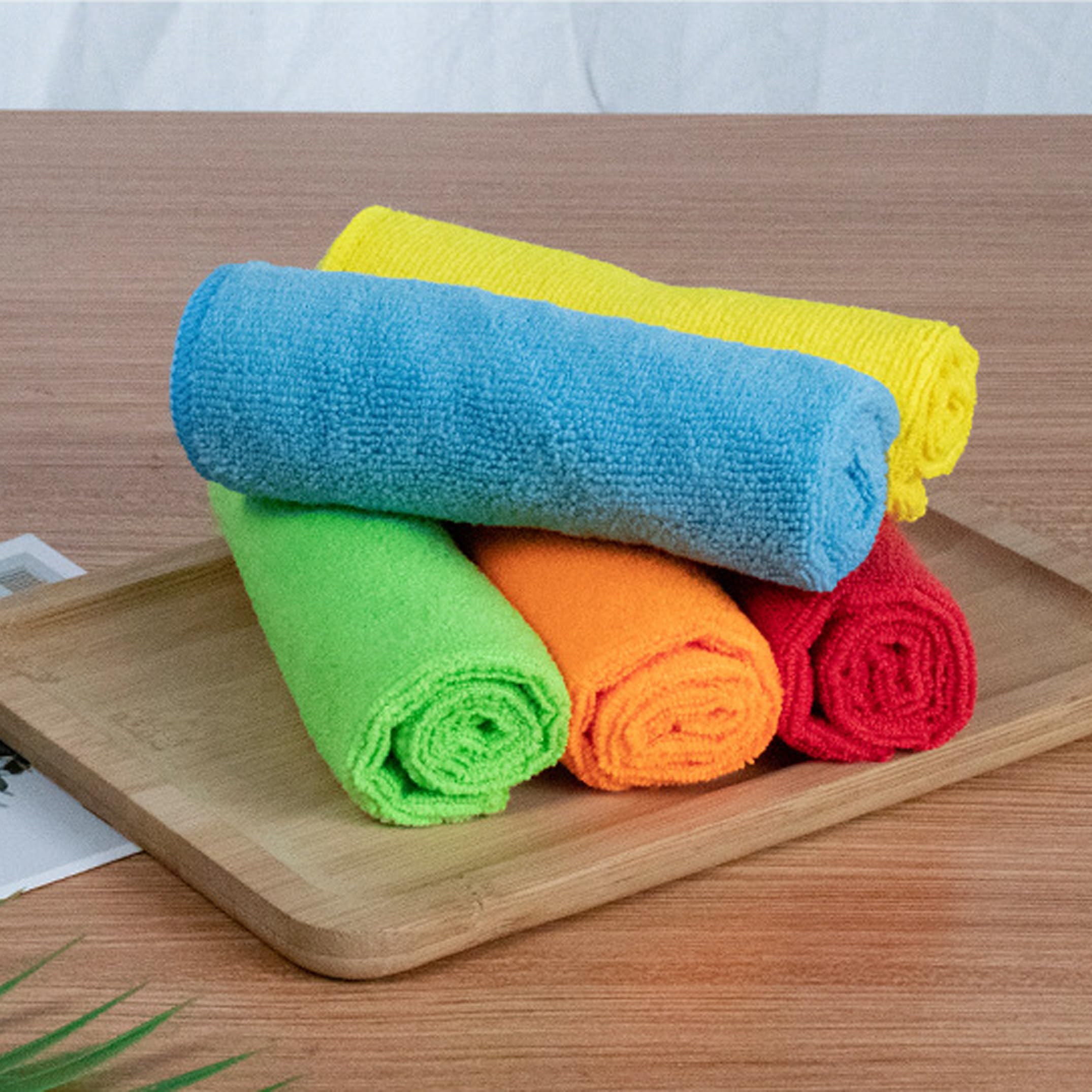
III. Color-Coding: More Important Than Buying Expensive Towels
Using a single towel for the entire vehicle is the most common mistake made during paintwork maintenance. The contaminants found on the lower body, wheels, glass, and interior surfaces are entirely different in nature. If iron particles or brake dust from the wheels are transferred to the vehicle’s paintwork via a cleaning cloth, even the highest-quality microfiber cannot save the clear coat from damage.
In a professional car wash process, towels are strictly categorized by color and intended use. A sensible setup includes: one large, high-GSM (grams per square meter) drying towel for the main body panels; two to three medium-sized, short-pile towels for detailing (drying paintwork edges, door jambs, and the area inside the fuel filler door); one dedicated glass towel (short-pile or waffle-weave to ensure a streak-free finish); and separate towels for the interior and wheels (typically in darker colors or clearly labeled). While color itself does not dictate quality, the visual cue it provides—signaling that towels must not be interchanged—serves as the first line of defense for your vehicle’s paint.
IV. Cleaning and Maintenance: The Lifespan of Microfiber Lies in the Details
The water-absorbent capacity of a microfiber towel stems from the capillary spaces between its fibers. Fabric softeners are the primary enemy of these spaces; they coat the fibers in a lipid film, effectively turning the material from “water-absorbent” to “water-repellent.” Similarly, detergents containing bleach or strong alkaline agents can corrode the polyamide components, causing the towels to stiffen and lose their elasticity over time.
Proper maintenance is straightforward: after use, rinse the towel with clean water to remove any residual car wash solution or grit. Then, machine-wash it using a neutral detergent at a temperature below 40°C. (It is best to wash these towels separately or with other microfiber items; avoid mixing them with cotton garments, as cotton lint can become trapped within the fibers.) Simply air-dry the towels, avoiding prolonged exposure to intense sunlight, which can cause the fibers to degrade. A high-quality microfiber towel, when maintained correctly, will retain most of its absorbency even after dozens of machine wash cycles—offering a significantly longer service life than ordinary towels.
One final note: it is recommended to wash new towels before their first use. Small amounts of residual lint or finishing agents may remain from the manufacturing process; a single wash helps the fibers fully “open up,” which actually improves their water-absorption performance.
V. A Pragmatic Approach to Your Toolkit
If you’d rather not get bogged down by dozens of different specifications, a “one large, three small” setup is a great place to start: one large drying towel (approx. 60×90 cm, 450 GSM or higher) for the main body panels; two smaller towels (approx. 30×40 cm)—ideally with a short-pile or dual-sided design—for detailing painted surfaces and glass; and one small, dark-colored towel reserved exclusively for wheels or the interior. This combination covers the vast majority of home car-washing scenarios, keeping costs reasonable while minimizing the risk of scratches.
Microfiber car-cleaning towels are not some mystical, pseudo-scientific product; their value is rooted in verifiable fiber specifications and proper usage habits. By understanding GSM (grams per square meter), being mindful of washing precautions, and consistently using color-coded towels for different tasks, you’ll find that the luster of your car’s paint—when viewed in the sunlight—truly lasts that much longer.
Post time: Nov-19-2026