

In the long journey of car maintenance, many owners tend to focus their attention on expensive waxes, sophisticated ceramic coatings, or professional detailing services that cost hundreds—if not thousands—of dollars. However, what truly determines whether a car’s paintwork retains its mirror-like luster over the long term is often not found in those bottles and jars, but rather in that seemingly insignificant item used during every wash: the towel.
The Gentle Trap: Why Are “Old Cotton Rags” the Invisible Killers of Car Paint?
Do you have a habit of grabbing an old cotton towel from the house—or perhaps a rag that has long since gone stiff—on a weekend afternoon to wipe away the dust and dew from your beloved vehicle? This seemingly thrifty and diligent act is, in reality, a form of “slow-motion murder” for your car’s paintwork.
While pure cotton feels soft to the touch, its fiber structure gradually hardens as it dries or ages; moreover, it is highly prone to trapping dirt and debris. When microscopic dust particles and grit—often invisible to the naked eye—become embedded within these fibers, they transform into countless tiny pieces of “sandpaper” during the wiping process. With every stroke, a minute scratch is etched into the clear coat layer of the paintwork. Over time, these scratches intertwine to form a web-like pattern; under direct sunlight, the paintwork takes on a dull, lackluster appearance characterized by swirling patterns—what we commonly refer to as “swirl marks.”
Worse still, ordinary cotton towels possess limited absorbency and often leave behind a thin film of water on the car’s surface after wiping. Once this moisture evaporates, the minerals dissolved within the water crystallize into stubborn water spots—leaving behind unsightly “scars” on the paintwork.
A Revolution in Materials: The “Golden Standard” of Microfiber and Suede
To break this vicious cycle, we require a revolution in materials. Modern automotive detailing practices have long since turned their attention to high-tech synthetic materials; among these, microfiber and synthetic suede undoubtedly stand out as the current “dynamic duo.”
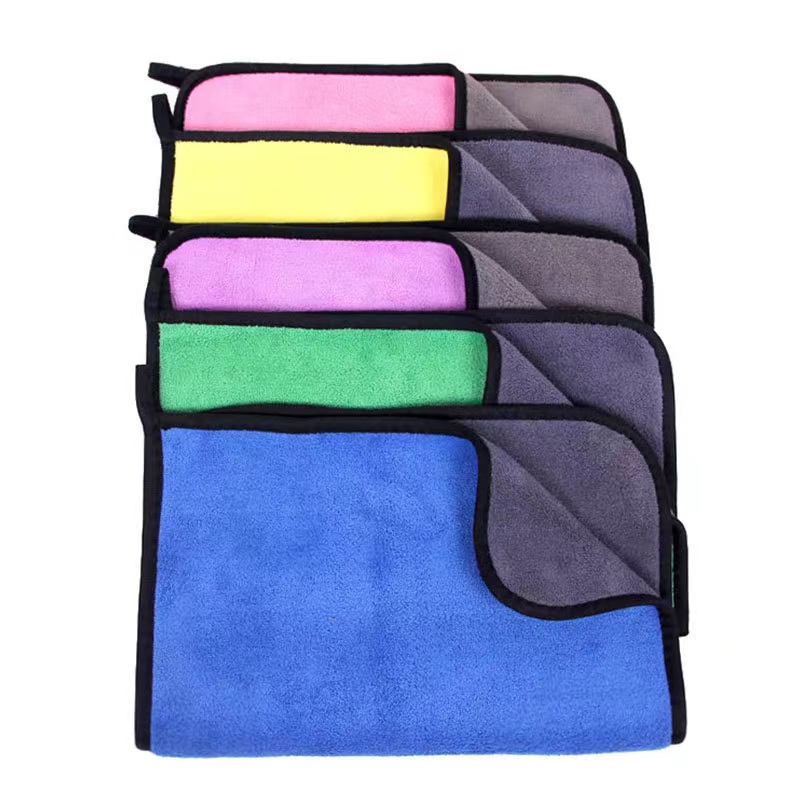
Microfiber—a material composed of fibers with a diameter just one-tenth that of a human hair—boasts an astonishingly high specific surface area. Its unique cross-sectional structure, resembling the segments of an orange peel, endows it with a powerful “wicking effect.” It no longer merely pushes water aside; instead, acting like countless tiny, slightly parted mouths, it actively “sucks” moisture deep into the fibers. Experimental data shows that high-quality microfiber towels can absorb over seven times their own weight in water, achieving a streak-free, instantly dry finish with just a single wipe.
Suede-like fabric, on the other hand, offers a distinctively premium experience. Possessing a silky-smooth touch, it is engineered specifically to pamper the most delicate paintwork. Its dense, velvety structure effectively traps fine dust particles rather than simply pushing them around. For car owners who demand the ultimate shine, suede-like towels not only whisk away moisture rapidly but also physically polish the paint surface through friction, leaving the finish not just clean, but gleaming with a deep, mirror-like luster.
The Right Tools for the Job: The “Philosophy of Specialization” for Car Towels
True experts in paint care never rely on a single towel for every task. Professional car detailing adheres to the principle of “specific cloths for specific purposes”—a practice driven not only by hygiene requirements but also by a deep respect for the unique characteristics of the paintwork on different parts of the vehicle.
Pre-wash and Main Wash: When the vehicle body is wet and covered in suds, use large, extra-thick coral fleece or waffle-weave wash mitts. These materials feature longer fibers capable of holding a large volume of foam and dirt, utilizing a “suspension effect” to minimize the risk of grit and sand particles making direct contact with the paint surface.
Drying and Water Removal: This is the most critical step. At this stage, switch to a dedicated drying towel—typically a microfiber or double-sided coral fleece towel measuring 60×90 cm or even larger. Unfold the towel and lay it flat across the hood or roof; then, gently drag it across the surface, allowing gravity and the towel’s superior absorbency to instantly wick away standing water.
Details and Glass: Car windows and interior display screens demand a level of cleanliness that leaves absolutely no lint behind. For these areas, short-pile microfiber towels or specialized glass-cleaning cloths are the optimal choice; they effortlessly wipe away fingerprints and oily films, restoring a crystal-clear, unobstructed view.
Wheels and Lower Skirts: These constitute the dirtiest areas of the entire vehicle, heavily contaminated with iron dust from brake pads and asphalt residue from the road. It is imperative to designate a specific towel—preferably one with a dark color and a relatively coarse texture—solely for cleaning wheels. You may even pair it with a dedicated wheel brush; under no circumstances should this towel be allowed to make any “intimate contact” with the vehicle’s paintwork.
**The Art of Maintenance: Wisdom for Extending a Towel’s Lifespan**
A high-quality car-drying towel can be a significant investment; therefore, knowing how to extend its useful life is a science in itself.
**When Washing:** Strictly avoid using fabric softeners or bleach. Fabric softeners create a thin film over the surface of the fibers; while this may make the towel feel softer to the touch, it effectively clogs the fibers’ microscopic pores, causing them to lose their absorbency. We recommend using a pH-neutral detergent and washing by hand in warm water, or using a gentle cycle in a washing machine.
**When Drying:** Avoid direct exposure to harsh sunlight. Ultraviolet (UV) rays are the nemesis of synthetic fibers; prolonged exposure causes the fibers to age, become brittle, and eventually disintegrate into dust. The best way to preserve a towel’s softness is to let it air-dry naturally in a cool, well-ventilated area.
**If the Towel Hardens:** Do not force it into use. Instead, soak it in warm water mixed with a small amount of white vinegar or a specialized towel restorer. Gently rub the towel, then rinse and let it dry; this process will breathe new life into the fibers.
**Conclusion: True Quality Lies in the Details**
The automobile is the pinnacle of industrial design and an extension of its owner’s personality. The luster of a car’s paintwork reflects not only the sunlight but also the owner’s attitude toward life.
Choosing the right towel is about more than just saving money on professional polishing and waxing; it is about experiencing that silky-smooth texture every time your fingertips glide across the vehicle’s body. This is not merely a cleaning task; it is a ritual of care and respect.
May every car enthusiast come to understand the “paint-protection philosophy” embodied by their towel, ensuring that their beloved vehicle remains as bright and pristine as the day it was new—even after enduring the passage of time.
Post time: Mar-31-2026