

Many car owners think washing a car is just rinsing it with water and wiping it dry with a cloth. But those who truly understand cars know that a good towel determines whether the paintwork can stay shiny and new for a long time. Seemingly ordinary car towels are actually indispensable “invisible guardians” in car detailing and daily maintenance.
I. Why Can’t You Use an Ordinary Towel to Wipe Your Car?
Household towels are mostly made of cotton, with rough fibers, prone to shedding, poor water absorption, and easily trapping dirt and grime. Using them to wipe the car body can not only leave small scratches on the paint (commonly known as “sun marks”), but may also cause secondary damage due to residual sand particles. Even worse, the chemical dyes or hard fibers in inferior towels can accelerate the aging of the car paint with long-term use.
Leave the professional work to the professional tools—car towels were created for this purpose.
II. Common Types of Car Towels
1. Microfiber Towel
- Features: Fiber diameter is only 1/10 that of silk, soft and delicate, highly absorbent, and lint-free.
- Uses: The most common type of car towel, suitable for drying the car body, windows, and interior.
- Advantages: High-density weave effectively absorbs dust and moisture, reducing friction damage.
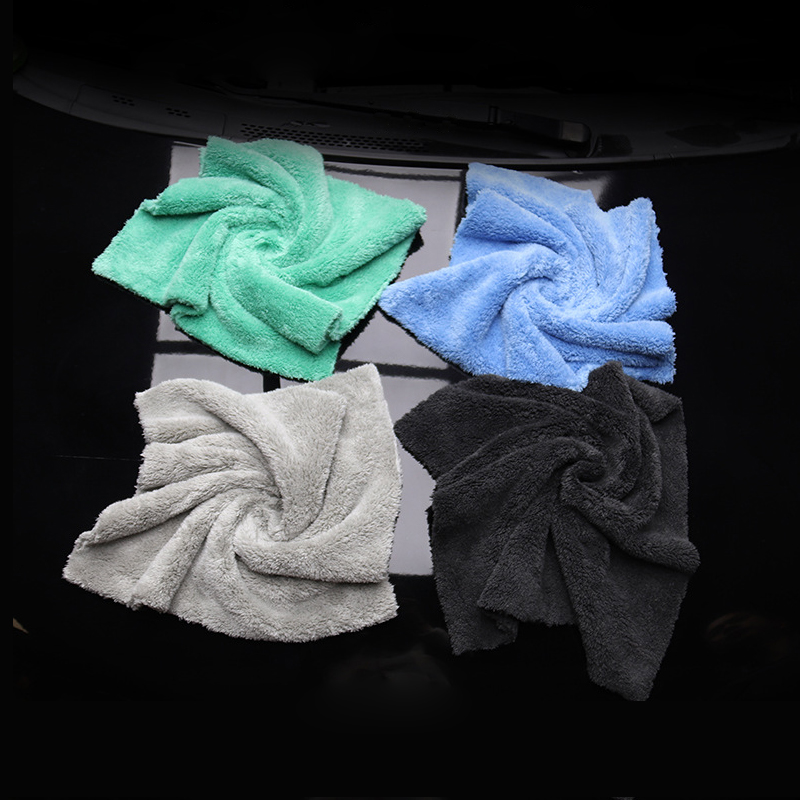
2. Coral Fleece Towel
- Features: Fluffy, coral-like surface, soft to the touch, and absorbs water quickly.
- Uses: Suitable for quickly drying the car body, especially in winter.
- Note: Some low-density coral fleece may trap dirt; it is recommended to use a dedicated towel for this purpose.
3. Polishing/Waxing Towel
- Features: Double-sided design; one side is for applying wax, and the other side is for polishing and brightening.
- Material: Usually made of high-density microfiber, lint-free, glue-free, and will not damage the paint.
III. How to Choose a High-Quality Car Towel?
1. Check the material: 100% microfiber is preferred, with a weight of 300g/m² or higher. Heavier towels are generally thicker and more durable.
2. Feel the texture: Soft and smooth, without noticeable roughness or lumps.
3. Test absorbency: Drop a drop of water. A high-quality towel will absorb and spread quickly, leaving no water droplets.
4. Check the workmanship: Strong edging, no loose threads, no odor. Avoid using bright white towels containing fluorescent agents.
5. Use them for different purposes: It is recommended to prepare towels of different colors or labels for the car body, wheels, interior, and glass to avoid cross-contamination.
IV. Usage and Maintenance Tips
Before first use: Rinse with clean water to remove production residue.
Avoid mixing: Towels used to wipe wheels (containing brake dust) should not be used to wipe the car body.
Washing method: Machine wash separately. Do not use fabric softener (it will clog the fiber pores and reduce absorbency). Regular Replacement: Replace the towel promptly when it becomes stiff, sheds lint, or its cleaning power decreases.
V. Conclusion: True Love is in the Details
The shine of a car doesn’t come from how often it’s washed, but from how carefully it’s wiped. A good car towel costs only a few dozen yuan, yet can save you hundreds or even thousands of yuan in polishing and repair costs. True car care is hidden in the details of every gentle wipe.
Your car, like a person, deserves to be treated gently. Starting today, give your vehicle a “personalized towel”!
Post time: Feb-10-2026