

Differences Between Cut-Edge and Hemmed High-Low Pile Towels
As an essential item in daily life, the craftsmanship details of a towel often determine the user experience. In recent years, high-low pile towels—characterized by a unique structure—have attracted increasing attention from consumers. The method used to finish the edges—specifically, cut-edge versus hemmed—directly impacts the towel’s performance and suitability for various applications. Understanding the differences between these two types helps consumers make the best choice for their needs.
The Unique Structure of High-Low Pile Towels
As the name suggests, high-low pile towels are created using a special weaving process that arranges high and low loops in an alternating pattern. This structure is intentional; the height difference between the loops typically ranges from 0.3 to 0.5 cm, with the taller loops reaching heights of 1.1 to 1.6 cm. This staggered design gives the towel a dual-function capability: the longer loops absorb moisture and dust, while the shorter loops handle wiping and cleaning tasks. Consequently, high-low pile towels are widely used in areas such as automotive detailing and furniture care.
Cut-Edge Process: Ultrasonic Heat-Sealing Technology
The cut-edge process—specifically ultrasonic laser cutting—uses the high heat generated instantaneously by ultrasonic waves to slice directly through the microfiber fabric. This technique results in a neat, clean edge without any hard seams. For applications like automotive detailing, the advantages of cut-edge towels are particularly notable: the edgeless design effectively minimizes the risk of scratching the vehicle’s paintwork during use.
Another feature of the cut-edge process is that, because the edge is sealed via heat fusion rather than stitching, there are no issues with unraveling or loose threads. This is a significant advantage for tasks requiring precision, such as wax removal or drying.
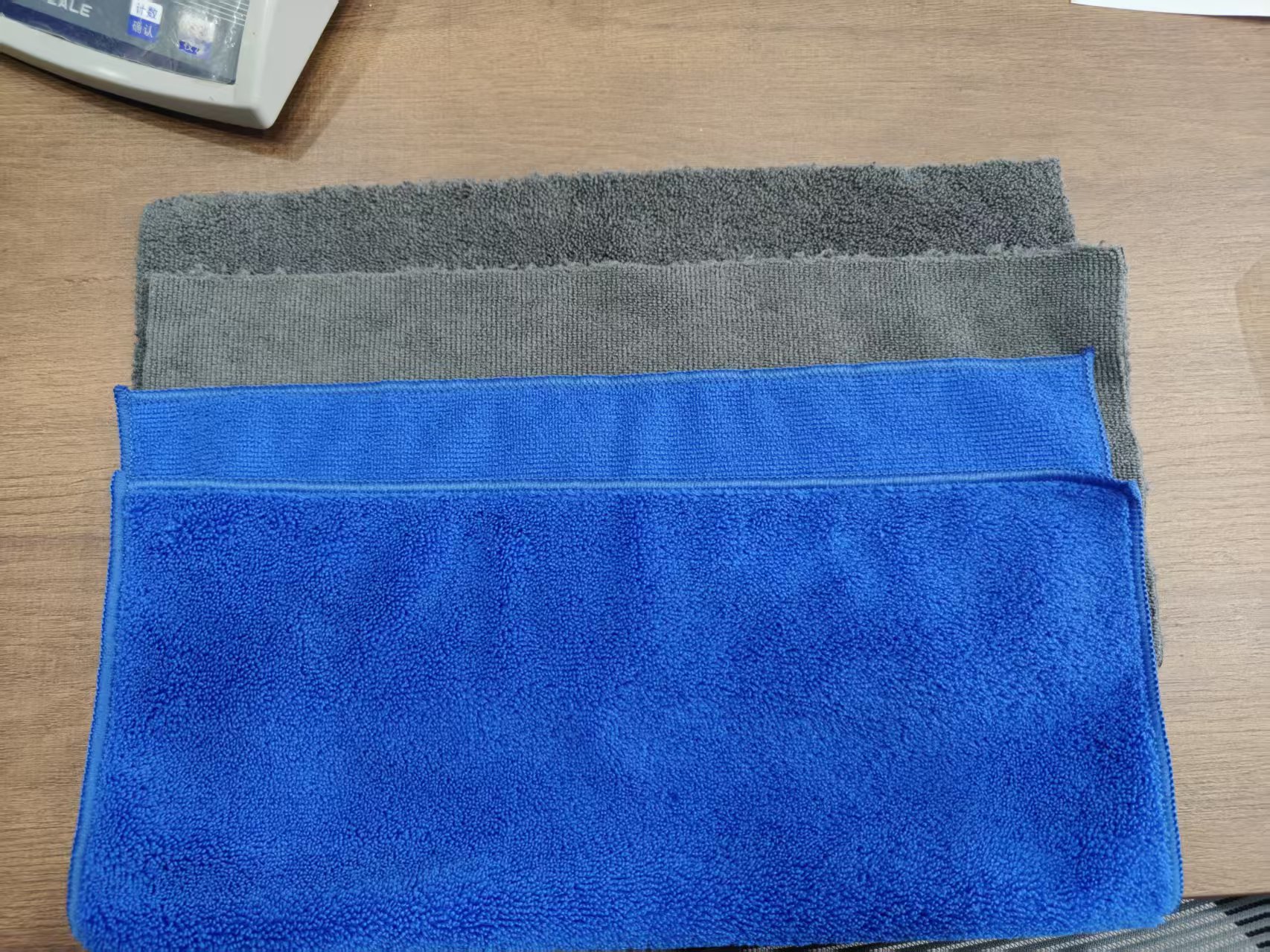
Hemming Process: Traditional Stitched Reinforcement
Hemming is the traditional method of finishing towel edges, involving the use of stitching to wrap and secure the towel’s border. The hemming thread is often made of microfiber and comes in varying levels of elasticity (high, medium, or low), with common thread specifications including 200D, 150D, and 300D. The advantages of hemmed towels lie in their sturdy construction and neat edges. For everyday household towels, hemming effectively prevents the towel from unraveling or losing its shape due to repeated washing. However, the presence of stitching and added thickness at the edge means that the hemmed area can potentially leave scratches or water marks when wiping delicate surfaces; consequently, they are less suitable for tasks like automotive detailing, which demand a scratch-free finish.
How to Choose
The choice of manufacturing process depends primarily on the intended use:
Scenarios suitable for laser-cut (edgeless) towels:
Car waxing, wax removal, and drying
Cleaning electronic products and precision instruments
Wiping furniture surfaces (where a streak-free/scratch-free finish is required)
Scenarios suitable for hemmed towels:
Everyday household use (face washing, bathing)
Kitchen cleaning
Scenarios requiring high durability
It is worth noting that edge finishing for towels is not limited to these two options; fabric binding is another common method that can be customized to specific needs. Ultimately, whether a towel is laser-cut or hemmed, the choice of process exists to meet the demands of different scenarios; there is no absolute “better” or “worse” option—only what best suits your specific requirements.
Post time: Jul-10-2026