

For car enthusiasts, washing your car is more than just cleaning; it’s a way to care for your paint. However, many people overlook a crucial detail: the car towel. A poor-quality towel can leave countless tiny scratches (commonly known as “sun marks”) on your beloved car’s paint after just a few uses, dulling its shine.
In 2026, while car detailing technology is increasingly sophisticated, microfiber towels remain the undisputed best choice. This article will provide an in-depth analysis of how to choose, use, and maintain your car towels to keep your vehicle looking brand new.
I. Why Must It Be “Microfiber”?
In the early days of car care, people used pure cotton towels, old T-shirts, and even sponges, but these materials often shed lint, had poor absorbency, or contained sand particles that could scratch the paint.
Microfiber has become the industry standard primarily due to its unique physical structure:
Extreme Fineness: A single fiber’s diameter is only 1/200th the diameter of a human hair. This ultra-fine fiber can penetrate deep into the microscopic pores of paint surfaces, carrying away dust and oil, unlike coarse fibers which push dust away.
Super Absorbency: The gaps between the fibers form an orange-petal-like structure, capable of absorbing seven times its own weight in water and dust. This means it can “lock in” dirt, reducing the risk of secondary scratches.
Quick Drying: Excellent breathability makes it less prone to bacterial growth and dries quickly, preventing odors.
II. Buying Guide: Understanding These 4 Key Indicators
Faced with a dazzling array of products on the market, how do you choose a good towel? Please pay attention to the following four core indicators:
1. GSM Value (Grammar Weight): Is Thicker the Better?
GSM (Grams per Square Meter) represents the weight per square meter, directly reflecting the towel’s thickness and pile density.
300-400 GSM: Suitable for cleaning interiors, wheels, or glass. Thinner, easier to wring out, suitable for delicate operations.
500-700 GSM: The first choice for drying water after car washes. Moderate thickness, strong water absorption, high softness, effectively traps sand and dust, protecting the paint.
800+ GSM: Top-of-the-line luxury experience, cloud-soft to the touch, suitable for polishing after coating or waxing, but more expensive and dries slightly slower.
Recommendation: For daily car wash drying, the 500-600 GSM double-sided thickened version offers the best value.
2. Weaving Technology: Flat Weave vs. Waffle Weave vs. Long Pile
Flat Weave: Smooth surface, often used for applying car wax or cleaners, large contact area, high uniformity.
Waffle Weave: Mesh surface, not only absorbs water quickly but also “hides” sand particles in the mesh grooves, greatly reducing the risk of scratches, making it the ideal structure for drying towels.
Long-pile/coral fleece: Longer fibers and an extremely soft feel, ideal for the final polishing step, removing fingerprints and watermarks.
3. Edge Design: Details Matter
High-quality car towels typically feature laser-cut, unbound edges or silk satin-bound edges.
Avoid: Rough stitching; these hard lines can easily scratch the paint when wiping.
Recommend: Unbound designs reduce contact with hard objects, or use soft satin to completely wrap the edges.
4. Color Management: Dedicated Towels for Dedicated Use
To prevent cross-contamination (e.g., transferring brake dust from the wheels to the car paint), a color-coding system is strongly recommended:
Blue: Car paint (cleanest)
Yellow: Glass cleaning
Red: Wheels, tires (dirtiest)
White/Gray: Interior leather, dashboard
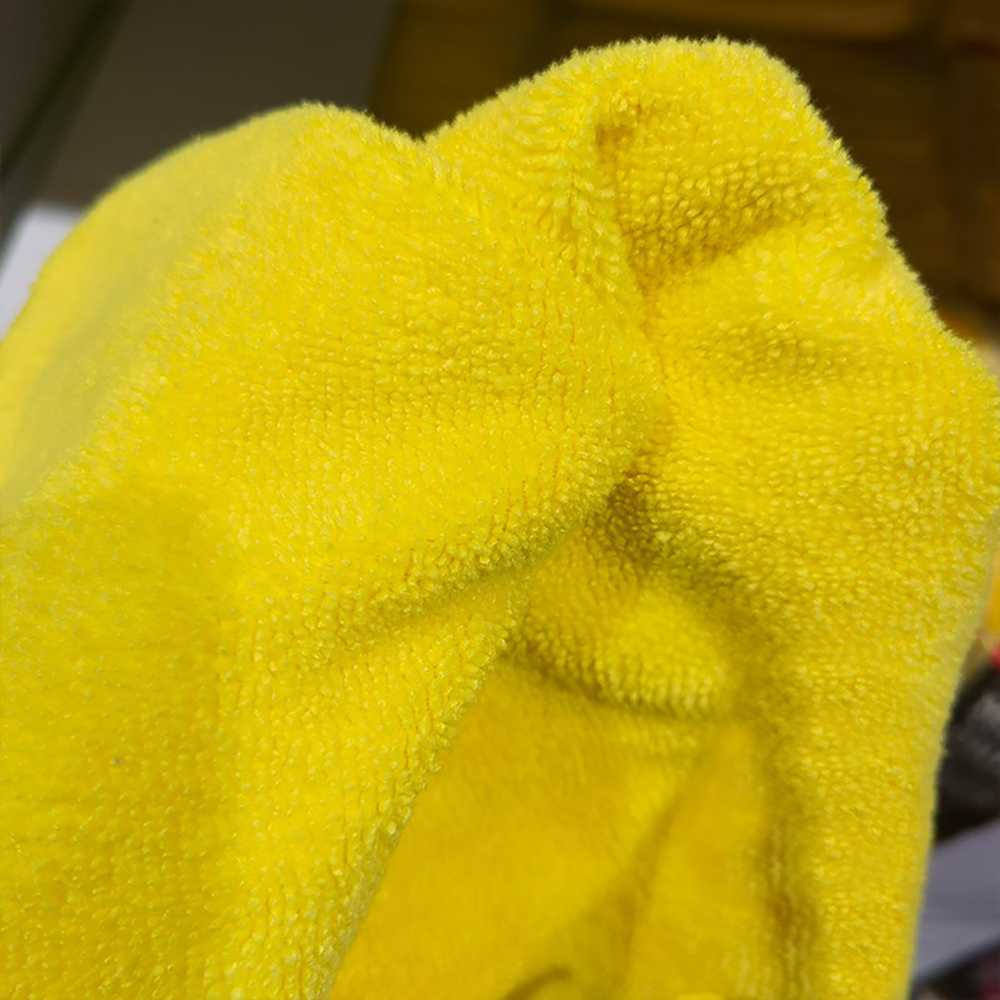
III. Avoidance Guide: Avoid These Pitfalls
Never use household bath towels or old clothes: Cotton towels have coarser fibers and easily retain detergent and fabric softener residue, resulting in poor absorbency and a tendency to develop sunspots.
Reject cheap “faux suede”: Traditional PVA faux suede, while highly absorbent, needs to be kept moist. Once dry, it hardens like a stone, becomes difficult to clean of internal dirt, and is prone to mold. Modern microfiber has completely replaced its function.
Don’t use the same towel to wipe the entire car: This is a common mistake for beginners. Different parts of the car have completely different levels of dirt; mixing towels is like sanding the paint.
IV. Cleaning and Maintenance: Extending Towel Life
A good microfiber towel, if properly cared for, can be used hundreds of times. Incorrect washing methods will ruin it instantly.
Wash separately: Never wash with cotton clothing or clothing with Velcro, as this can cause lint to stick or the Velcro to snag the fibers.
Special detergent: Use a neutral laundry detergent; never use fabric softener. Fabric softener forms an oil film on the fiber surface, clogging the micropores and causing
Post time: Feb-26-2026