

The “Edge” Story of Microfiber Warp-Knit Towels: Cut-Edge vs. Stitched-Edge—Did You Make the Right Choice?
In the world of microfiber towels, “warp-knitting” signifies a high-quality weaving process that grants the towel superior absorbency and cleaning power. However, you might not have noticed that the way the towel’s edge is finished profoundly affects both the user experience and the product’s lifespan. The two mainstream techniques on the market today—cut-edge and stitched-edge—may seem like mere differences in finishing steps, but they actually represent two completely different product philosophies.
Today, we will delve into the fundamental differences between these two processes to help you choose the one that best suits your specific needs.
Act I: The “Watershed” of Technical Fundamentals
Cut-edge finishing (exemplified by ultrasonic or laser cutting) is essentially a process of “physical fusion.” It utilizes high-frequency ultrasonic vibrations or high-energy laser beams to generate instant high heat, slicing directly through the microfiber fabric. Simultaneously, the heat causes the synthetic fibers (polyester, nylon) at the cut site to melt rapidly and re-solidify, forming a smooth, fused band. No needles or threads are involved in this process; the “sealing” of the edge relies entirely on the fusion of the fibers themselves.
Stitched-edge finishing, on the other hand, is a classic “mechanical sewing” process. It employs a specialized overlock sewing machine and high-strength thread (usually high-elasticity yarn or nylon thread) to wrap and stitch along the cut edge of the towel. Countless fine stitches tightly encase the fabric edge, creating a robust physical lock that prevents the fibers from unraveling.
Act II: A Showdown of Appearance and Tactile Feel
When you hold the two types of towels in your hands, the differences are immediately apparent.
Visually:
The edge of a cut-edge towel features a uniform, seamless fused line; it has virtually no thickness, creating a minimalist, clean look. Some ultrasonic cutting machines can even emboss exquisite wave patterns or decorative scallops onto the edge, adding a touch of sophisticated design. The edge characteristics of hemmed (stitched-edge) towels are very distinct: you can clearly see one or two parallel rows of even, fine stitching—a hallmark of traditional textile manufacturing.
Regarding tactile feel (this is the key difference):
The edges of cut-edge towels are extremely soft and smooth, feeling almost identical to the body of the towel itself; there is no sense of resistance when you run your fingers across them. In contrast, the edges of hemmed towels feature layers of folded fabric and accumulated stitching, creating a noticeably stiffer “ridge” where you can sometimes even feel the texture of the stitches.
Act III: The Trade-off Between Durability and Usage Scenarios
The durability of these two manufacturing methods depends on different factors.
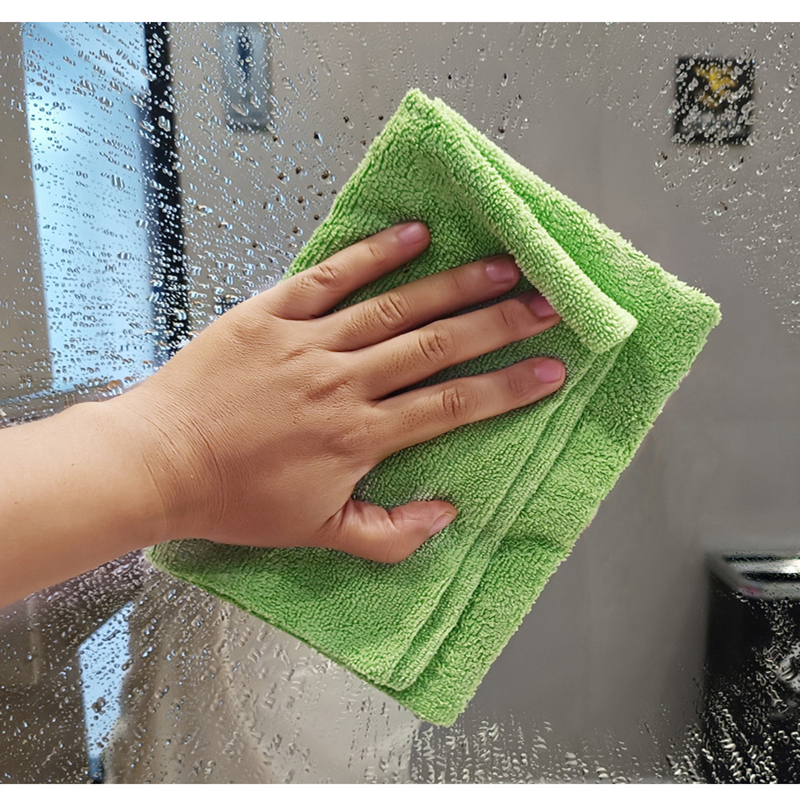
Cut-edge towels—strengths and weaknesses:
Their greatest advantage is that they do not shed lint or fibers. Because the edge is fused into a single, solid unit, the tiny microfiber strands are firmly “welded” to the main body, drastically reducing the likelihood of lint shedding during wiping. This is why they are highly favored in precision cleaning applications.
However, note that if ultrasonic power is insufficient or the fusion is incomplete, there is a slight risk of the edge “opening up” after prolonged, intense pulling or high-temperature washing; once the fusion line breaks, the resulting separation is more severe than with hemmed edges.
Hemmed towels—a bastion of sturdiness:
With high-quality hemming, the strength of the stitching often exceeds that of the fabric itself. As long as the thread remains intact, the edge is virtually indestructible. These towels are highly resistant to pulling and can withstand rougher machine washing and spin-drying cycles. However, if the hem thread snaps due to wear and tear, the edge may begin to unravel, ultimately shortening the towel’s lifespan.
A final tip:
Regardless of which type you choose, proper care is the key to extending the towel’s life:
Cut-edge towels: Avoid excessively high water temperatures during washing (keeping it below 60°C is recommended) to prevent high heat from compromising the stability of the fused edge.
Hemmed towels: Check the stitching for any loose threads; if you spot a loose end, trim it immediately to prevent it from snagging and unraveling further. Conclusion: There is no absolute right or wrong choice between cut edges and stitched edges—only what is most suitable. Cut edges represent “craftsmanship-driven technology,” using thermal fusion to safeguard precision; stitched edges embody “classic heritage,” using needle and thread to ensure durability for everyday use. By understanding the differences, you can ensure that your microfiber warp-knit towel delivers maximum value in the specific application where it excels. Next time you make a purchase, simply ask yourself: “What exactly will I be using this to wipe?”
Post time: Jul-15-2026