

The Secret Weapon for Restoring Your Car’s Shine: How to Choose and Use Car Towels
In the world of car care, enthusiasts often love to discuss expensive car waxes, high-tech ceramic coatings, or premium car wash soaps, yet they frequently overlook one of the most fundamental—and absolutely critical—tools: the car towel.
A low-quality towel can leave countless tiny scratches (often appearing as “swirl marks” in sunlight) on your meticulously cleaned vehicle, whereas a professional, high-quality towel can leave your paintwork gleaming like new—and even enhance the performance of your ceramic coatings and waxes. Today, let’s take a deep dive into the surprising science behind this humble “little towel.”
I. Why You Shouldn’t Use Ordinary Household Towels to Dry Your Car
For the sake of convenience, many car owners simply grab an old bath towel or face cloth from their home to dry their car; however, this is actually an “invisible killer” for your vehicle’s paintwork.
**Fiber Roughness:** Household towels are typically made of cotton, a material with a relatively rigid fiber structure. Under a microscope, the ends of cotton fibers resemble tiny saw blades. When these fibers—carrying microscopic dust particles from the air or the car’s surface—rub against the paintwork, they inevitably cause minute scratches.
**Lint Shedding:** Ordinary towels are prone to shedding lint. After drying the car, the vehicle’s surface ends up covered in white fuzz—not only does this severely compromise the car’s aesthetic appeal, but it also makes the subsequent cleanup process time-consuming and laborious.
**Absorbency Differences:** The water absorption speed and water-retention capacity of household towels are far inferior to those of professional microfiber towels. This often leads to residual moisture being left behind during the drying process, resulting in stubborn water spots (water marks) that are difficult to remove.
II. The Core Technology: Understanding Microfiber
The standard tool in the modern car detailing industry is the microfiber towel. This material is typically woven from a specific blend of polyester and polyamide (nylon) fibers.
**The Splitting Process:** High-quality microfiber undergoes a specialized “splitting” process during manufacturing, in which a single filament is split into thousands of extremely fine strands. This creates an enormous surface area, allowing the material to act like a magnet—attracting and trapping dust and dirt particles rather than merely pushing them around across the paintwork. **Golden Ratio:** Common ratios include 70/30, 80/20, or even 85/15 (Polyester/Polyamide). Generally speaking, the higher the polyamide content, the softer the towel and the greater its absorbency, making it ideal for final drying and polishing of painted surfaces; conversely, a slightly higher polyester content offers better durability and abrasion resistance, making it suitable for cleaning wheels or interior surfaces.
**GSM Value (Gram Weight):** This metric measures a towel’s thickness and density.
**300–400 GSM:** Suitable for cleaning interiors, glass, or serving as a pre-wash towel.
**500–700 GSM:** Ideal for drying the vehicle after washing, offering high absorbency and softness.
**800+ GSM:** Typically used for high-end waxing, sealant application, and polishing; these towels are extremely soft and will not strip away freshly applied protective layers.
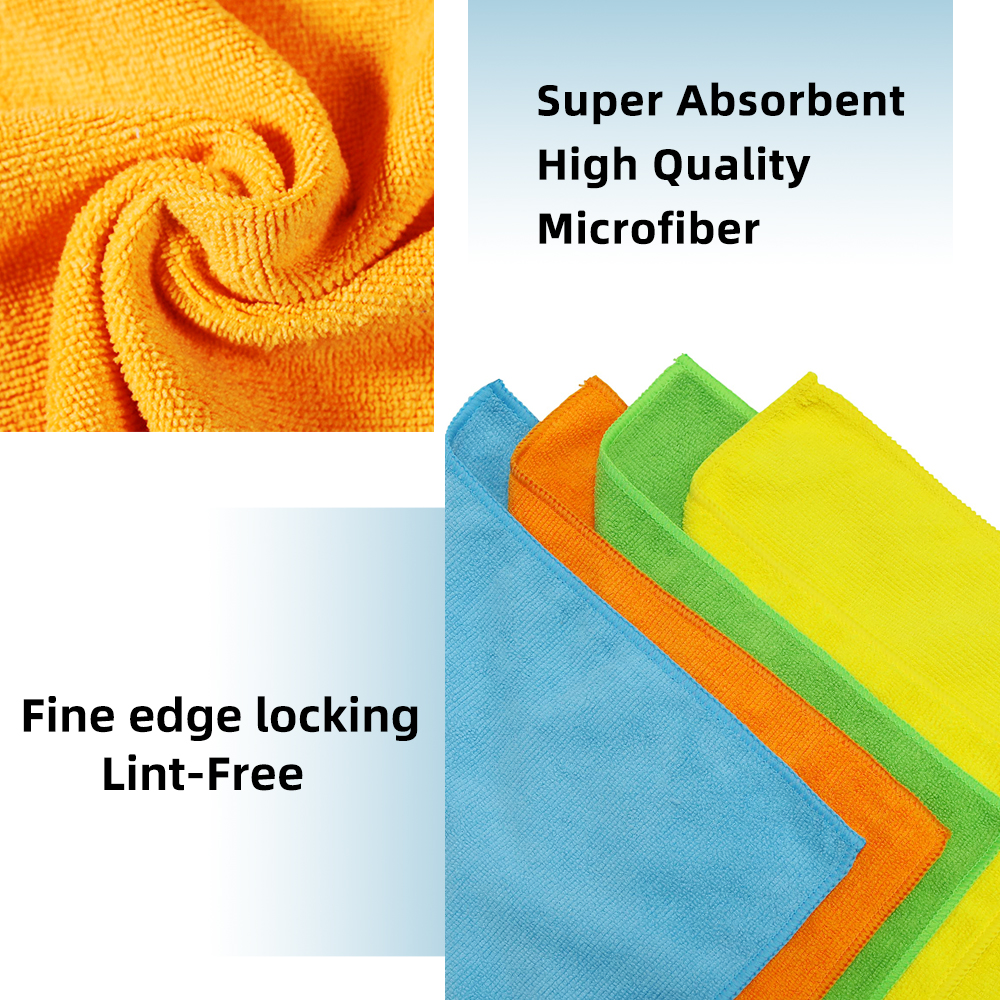
**III. Contextual Selection: Specialized Towels for Specific Tasks**
To achieve optimal results and prevent cross-contamination, it is recommended to adhere to the principle of “one towel, one purpose.” You should prepare at least the following three types of towels:
**1. Drying Towel**
**Features:** Large dimensions (typically 60×90 cm or larger), high GSM value (500+), and featuring a Waffle Weave or long-pile construction.
**Purpose:** After the vehicle has been rinsed, utilize the towel’s powerful capillary action to instantly wick away water droplets from the bodywork, thereby minimizing wiping motions and reducing the risk of scratching.
**Tip:** Avoid scrubbing back and forth vigorously; instead, lay the towel flat across the vehicle’s surface and gently drag or press it down.
**2. Buffing/Polishing Towel (for Detailing & Waxing)**
**Features:** Medium size, edgeless design (to prevent tags or seams from scratching the paint), extremely high GSM value (700+), and a silky-smooth texture.
**Purpose:** Used for applying car wax, sealants, or ceramic coatings, or for buffing the surface to a high shine after these products have dried. These towels must be kept absolutely pristine and free of any hard particles. 3. Interior & Glass Towels
Features: Mesh-weave structure (for Glass Towels) or standard short-pile nap; moderate GSM rating (300–400).
Uses:
Glass Towels: The specialized mesh weave ensures no water spots or lint are left behind, leaving glass surfaces crystal clear and streak-free.
Interior Towels: Used for wiping down dashboards, seats, and door panels. Since interior surfaces tend to accumulate significant dirt, these towels should be deep-cleaned or replaced regularly; strictly avoid using them on painted exterior surfaces.
Note: For cleaning wheel rims, it is highly recommended to use a separate, dedicated towel—preferably an old one or a specifically designated dark-colored towel. Brake dust is highly corrosive and extremely difficult to wash out completely; using the same towel for both wheels and paintwork will inevitably ruin your car’s finish.
IV. Cleaning and Maintenance of Car Towels
Even a towel costing thousands can have a lifespan of just a few uses if cleaned improperly. Proper maintenance techniques can significantly extend a towel’s service life and preserve its performance:
Wash Before First Use: New towels may retain residual manufacturing oils or loose fibers from the weaving process; it is essential to wash them once before using them on your vehicle.
Avoid Fabric Softeners: This is the most critical rule! Absolutely never use fabric softeners. Softeners create a waxy film on the surface of the fibers, clogging the microscopic gaps between them and causing the towel to lose its absorbency and dust-trapping capabilities.
Gentle Washing: Use a pH-neutral laundry detergent and keep the water temperature between 30°C and 40°C. Ideally, wash them separately to avoid mixing with clothing that has zippers or buttons, which can snag and damage the fibers.
Air Dry or Low-Heat Tumble Dry: Avoid drying in direct sunlight or using high-heat settings in a dryer. High temperatures can melt the polyester components within the microfiber material, causing the towel to become stiff and hard.
V. Conclusion
In the chain of automotive care, the towel represents the final physical contact with the paintwork—making it a pivotal link in determining the ultimate shine and luster of your vehicle. Investing in a few high-quality microfiber towels, coupled with the habit of proper usage and cleaning, is not merely an act of protecting your beloved car; it is a reflection of a refined and meticulous approach to living. The next time you head toward your beloved car with a towel in hand, remember this: what you hold is not merely a piece of cloth, but a shield—one that safeguards the luster of your vehicle’s paintwork. Choose the right “shield,” and let your car dazzle brilliantly every time it makes an appearance.
Post time: Mar-13-2026