

The Ultimate Guide to Car-Drying Towels: Don’t Let the Wrong Towel Ruin Your Car’s Paint
Many car owners are willing to spend thousands on ceramic coatings or hundreds on premium car wash soaps, yet they’ll grab just any old towel to dry their vehicle. This is perhaps the most insidious “paint killer” in car maintenance. Not just any cloth will do; the fiber structure, weave, fabric weight, and even the way you use a towel determine whether your paint ends up looking more brilliant—or increasingly covered in scratches.
Why Ordinary Towels Shouldn’t Be Used on Cars
Most household towels are made of cotton or cotton blends. As cotton fibers dry, they retain bound water, causing the towel to become stiff and lose its elasticity—a state that makes it easy for the fabric to trap and hold onto abrasive grit. Furthermore, cotton has limited absorbency, often leaving behind water spots, and it is far more prone to shedding lint than specialized automotive towels. Using such a towel on a paint surface covered in fine dust is effectively the same as lightly sanding the clear coat with fine-grit sandpaper. While the damage might not be immediately apparent, over time, “swirl marks” and micro-scratches will become glaringly obvious, especially on darker-colored paint.
Even among dedicated microfiber towels, there is a wide range of quality. Common weaves include warp-knitted and weft-knitted types. Low-quality towels—those with a lower fiber density—tend to have poor absorbency, a stiff feel, a short lifespan, and may even shed lint. In contrast, high-density microfiber towels are soft, highly absorbent, feature a distinct weave, and are lint-free—making them the ideal choice for those who truly care about their vehicle’s finish.
Choosing the Right Material: Microfiber Is the Baseline
Microfiber is currently the gold standard for car-drying towels. The individual fibers are incredibly fine; through a “splitting” process, each fiber is divided into multiple strands, creating a vast network of microscopic pores that can trap dust, oil, and water. High-quality microfiber is exceptionally absorbent—capable of holding several times its own weight in water—and remains soft and lint-free even after repeated use. When purchasing, pay attention to the fiber composition. A 70/30 polyester/nylon blend is highly regarded in professional detailing and is considered safer than the more common 80/20 blend.
Coral fleece is soft to the touch and suitable for interior surfaces or light wiping of paintwork; however, its water-absorption capacity is generally lower than that of high-GSM microfiber, making it better suited specifically for interior cleaning. Bamboo fiber offers some antibacterial properties and dries quickly, making it useful for cleaning seats and interior trim panels; however, it lacks the capacity to absorb large volumes of water, requiring frequent wringing out.
GSM and Size: Large Towels for Drying, Smaller Towels for Detailing
GSM (grams per square meter) is a direct indicator of a towel’s thickness and water-absorption capacity. Standard car-care towels typically range from 300 to 600 GSM; for drying towels, look for products with a rating of 600 GSM or higher. A thicker towel reduces the need for repeated wiping, thereby lowering the risk of surface abrasion.
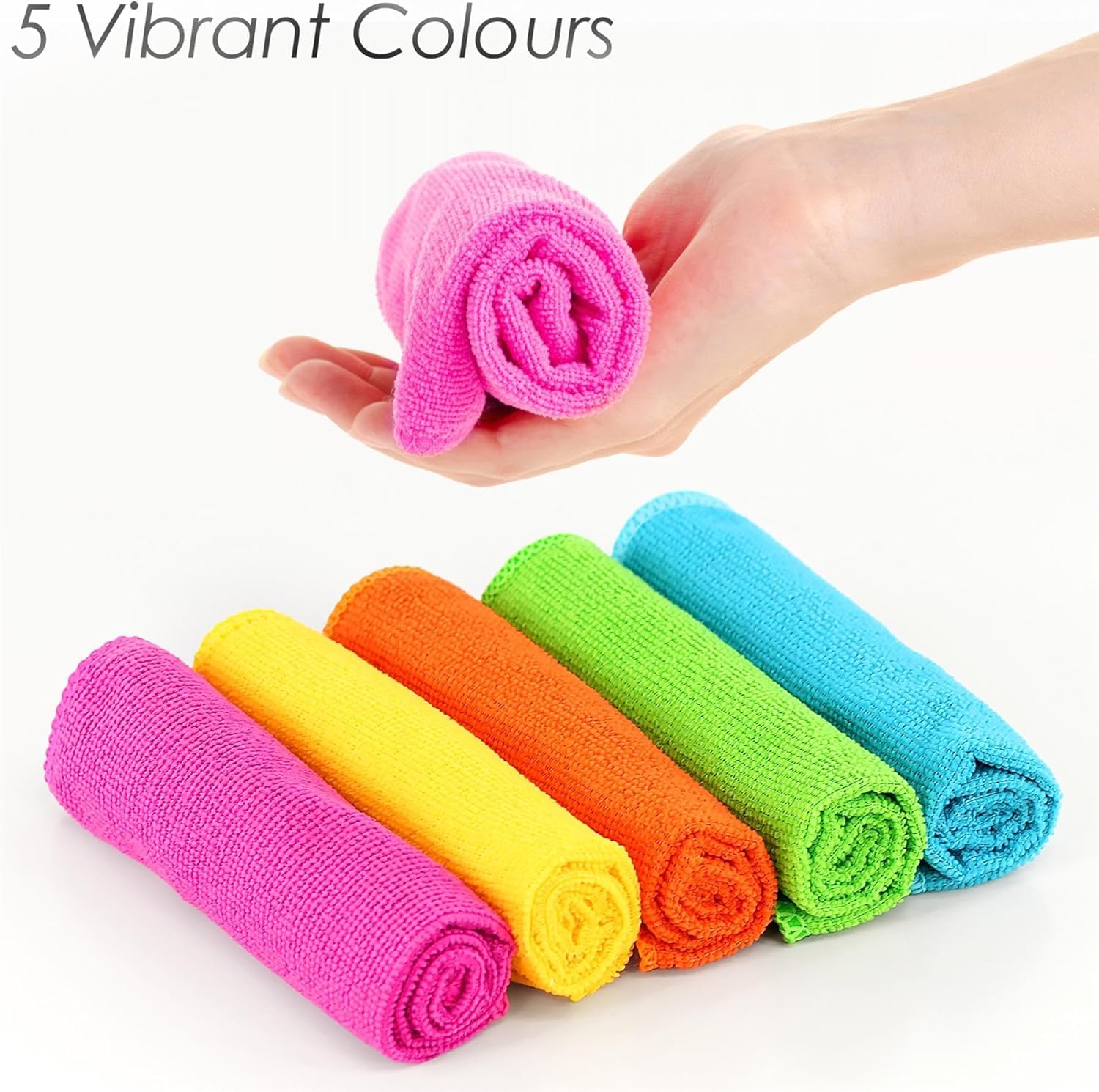
In terms of sizing, a practical setup includes: one large drying towel (approximately 60×160 cm or larger) for quickly drying the vehicle’s exterior; several medium-sized towels (approximately 30×40 cm) for detailing paintwork, door jambs, and wheel areas; and separate, color-coded towels for interior surfaces and glass to prevent cross-contamination. Color-coding is essential—dark-colored towels may hide dirt, which can lead to overlooking trapped grit or sand particles. Light-colored towels are preferable for cleaning, as they make it immediately apparent when they have become soiled.
Usage and Maintenance: Separate by Task, Avoid Fabric Softeners, and Air-Dry in the Shade
The golden rule for car-care towels is to use them exclusively for specific areas. Never use a towel that has come into contact with dirt or grit (such as those used during the wash phase) for drying the vehicle, and never use a towel that has touched the wheels on the paintwork. Once grit becomes embedded in the fibers, even the softest towel can turn into an abrasive tool. It is recommended to keep at least three separate sets of towels—one for the exterior paint, one for glass, and one for the interior—using different colors for each to ensure they are never mixed up. Use a neutral detergent for cleaning, and never add fabric softener. Fabric softener creates a film on the fibers, clogging the microscopic pores of the microfiber and effectively destroying its water-absorbency. If machine-washing, select a gentle cycle; avoid high-heat tumble drying or direct sun exposure—simply air-dry in a cool, well-ventilated area. Wash new towels separately before their first use to remove any residues that may have accumulated during production or transport.
Another often-overlooked detail: try to wipe your car in a shaded area. In direct sunlight, the vehicle’s surface temperature rises, causing water to evaporate too quickly. This leads to water spots forming before the towel can absorb the moisture, forcing you to wipe the surface repeatedly—which only increases unnecessary friction.
In short:
A high-quality car-drying towel is inexpensive, yet it protects a paint finish worth thousands or even tens of thousands. Microfiber is the baseline, color-coding and zoning are the rules, and fabric softener is strictly forbidden. Treat your drying towel as a maintenance tool rather than a disposable item; your car’s paintwork will reflect the value of that choice.
Post time: Nov-25-2026