

Twisted-Strand Car-Drying Towels: Why Do These Mop-Like Cloths Cost More Than Regular Towels?
When people first encounter a twisted-strand car-drying towel, they are often taken aback: it looks like a miniature mop, with strands of fiber twisted into little braids that hang from the surface—a far cry from the standard microfiber towels found in supermarkets for just a few dollars. Why, then, does it command a higher price? The answer lies in the term “twisted.”
Twisting fibers into strands accelerates water removal.
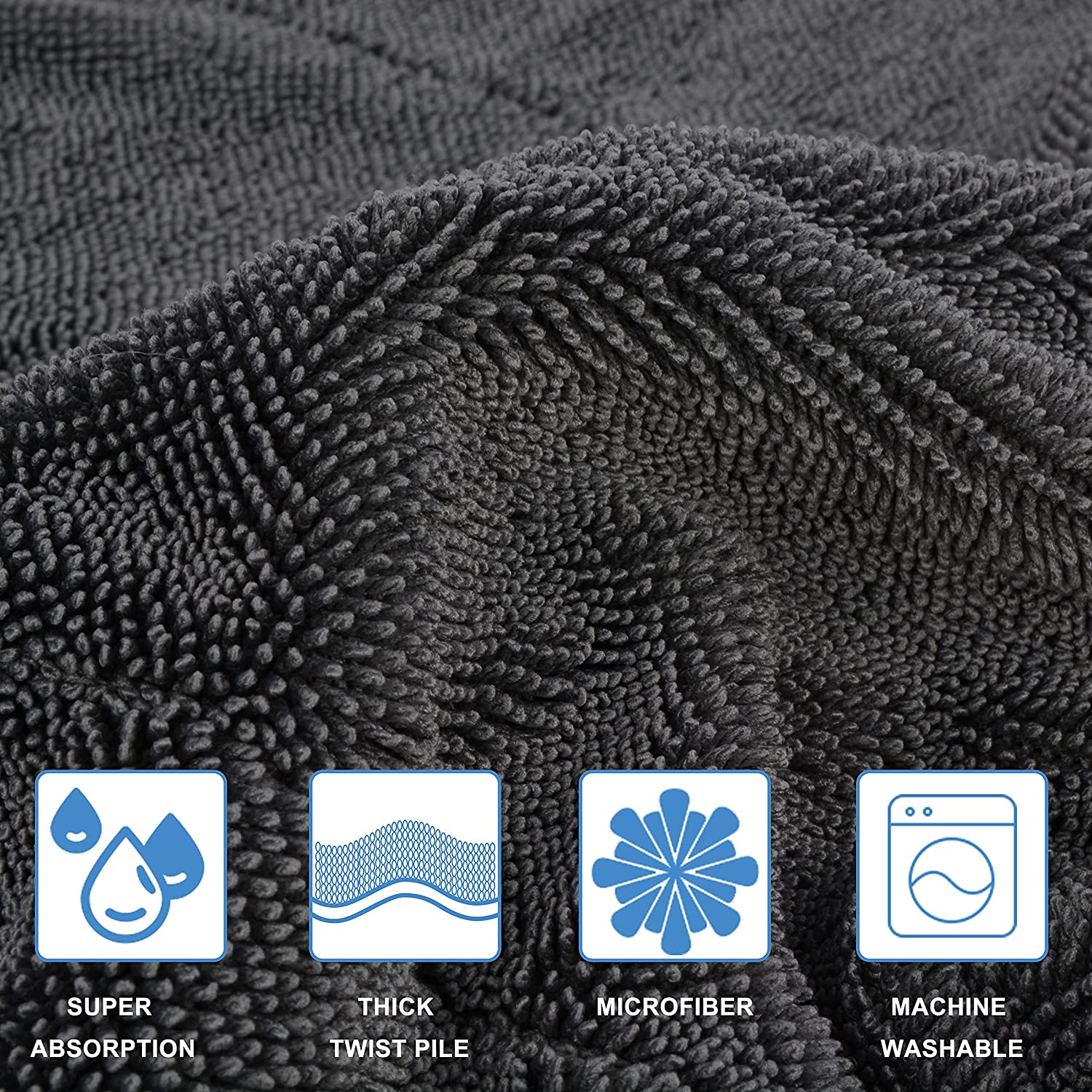
Standard microfiber towels absorb water through the pores on the surface of their fibers—the water essentially “seeps” in. Twisted-strand towels take a different approach: during the weaving process, the fibers are twisted into spiral-like braids. The ends of these “braids” fan out, significantly increasing the surface area. When water comes into contact with these twisted fiber bundles, it doesn’t just seep in slowly; it is rapidly channeled away along the spiral paths. In actual product testing, one such towel increased in weight from 29 grams (dry) to 115 grams when fully saturated—meaning it can absorb roughly three times its own weight in water.
Another advantage of this structure is that it is less likely to trap sand or grit. In standard short-pile towels, the dense fibers can easily harbor tiny dust or sand particles, which are difficult to wash out completely—potentially causing scratches the next time you use the towel on your car. In contrast, the twisted-strand design features larger gaps between the strands, and the individual strands themselves are thicker; this prevents dirt from becoming lodged deep within the fibers, making it much easier to rinse away. For those who wash their own cars and prefer not to use a fresh towel every single time, this feature is arguably even more practical than high water-absorption capacity.
Weight (GSM) and dimensions have a greater impact on the user experience than the “twisting” process alone.
There is a wide range of weights (GSM) available for twisted-strand car-drying towels on the market. Entry-level towels typically have a density of around 600 GSM (grams per square meter), which already feels quite substantial. However, products specifically designed for drying vehicles often feature a higher GSM; some manufacturers offer double-sided, extra-thick versions reaching 1200 GSM—resulting in a thickness of approximately 2 mm for a 40×40 cm towel, and up to 3 mm for a 40×60 cm version. A higher GSM allows the towel to hold more water, meaning you don’t have to wring it out as frequently when drying large surfaces like the hood or roof.
When it comes to size, it is better to exercise some restraint. A 40×60 cm towel is the go-to choice for drying; it provides sufficient coverage while remaining manageable enough to wring out with one hand even when fully saturated. While a 60×90 cm towel offers greater drying efficiency, it becomes quite heavy once soaked—which can be physically demanding if you are reaching over the roof without the aid of a vehicle lift. Smaller sizes, such as 30×40 cm or 40×40 cm, are better suited for detailing interiors, door jambs, or wheels, or simply for keeping on hand as an emergency towel. Some users find that a 30×30 cm towel is convenient because it takes up very little space in the car and is perfectly adequate for routine washing tasks.
A double-sided design is more than just a marketing gimmick—provided it is used correctly. Many “twisted-loop” (or “braided-pile”) drying towels feature a dual-sided construction: one side consists of long, twisted-loop fibers, while the other features a mesh-like fabric. The long-pile side is intended for drying, while the mesh side is designed for tackling stubborn stains or cleaning glass. This design is logical; the mesh side lacks pile, which reduces friction when sliding across smooth surfaces, making it less likely to leave behind water streaks or lint.
However, a word of caution: the mesh side should not be used on paintwork that has already been rinsed clean. Its cleaning power comes from a stiffer weave, which poses a higher risk of scratching the paint if used without proper lubrication. The correct approach is to use the long-pile side for drying the paintwork, while reserving the mesh side for glass, wheels, or areas that may still have residual dirt before the final rinse. The warning about “slight shedding” is accurate.
Multiple sources note that “twisted-loop” (or “braided-loop”) microfiber drying towels may shed slightly during their first use. This is not a quality defect; rather, it is an inherent characteristic of the twisted-loop construction, where the ends of the fibers are exposed. The shedding typically stabilizes after one or two washes. However, if a towel continues to shed after five or six uses, it indicates an issue with the manufacturing process or the raw materials—not the inherent design.
It is essential to avoid fabric softeners when washing these towels; softeners can clog the fiber pores, effectively sealing off the absorbent channels created by the twisted-loop structure. By using a neutral detergent, air-drying the towel, and washing it separately from clothing, a high-quality twisted-loop towel can easily withstand dozens of car-drying sessions.
A twisted-loop towel is not strictly a necessity. A decent short-pile microfiber drying towel can also dry a vehicle effectively without leaving scratches. However, if you prioritize drying efficiency, dislike water dripping everywhere while wringing out a towel, or are tired of standard towels shedding or becoming stiff after just a few uses, then this type of towel offers a practical solution to those specific frustrations. The extra cost pays for the clever fiber engineering—and the convenience of needing to wring out the towel less frequently while drying your car.
Post time: Oct-23-2026