

Weft-Knitted Microfiber Towels: A Comprehensive Analysis from Construction to Performance
When purchasing microfiber towels, consumers often focus on metrics like fabric weight (GSM), material composition, or marketing claims—such as “absorbs X times more water than a standard towel.” Yet, a more fundamental distinction is frequently overlooked: whether the towel is warp-knitted or weft-knitted. While this may seem like a purely technical manufacturing detail, it actually dictates the towel’s elasticity, edge stability, tactile feel, and even its overall lifespan.
Weft-knitting is the primary construction method used for most “microfiber car-detailing towels,” “hair-drying towels,” and “cleaning cloths” found on the market today. Understanding the strengths and limitations of this method is far more meaningful than simply comparing raw specifications.
How Weft-Knitted Fabrics Are Made
Knitted fabrics are formed by bending yarn into loops and interlocking those loops. Depending on the direction in which the yarn is fed, the process is categorized into two types: warp-knitting and weft-knitting.
In weft-knitting, one or more yarns form loops sequentially across the width (the “weft” direction) of the fabric. You can visualize this like hand-knitting a sweater: the yarn travels from left to right to create a single row, with subsequent rows built on top. Because the yarn moves back and forth horizontally, a single continuous strand could—theoretically—form an entire piece of fabric (though, in industrial production, multiple yarns are typically used simultaneously to increase efficiency).
Warp-knitting, by contrast, operates quite differently. Yarns are fed longitudinally (in the “warp” direction), with each individual yarn forming a vertical chain of loops. The lateral connection between these loops is achieved by interlocking the various yarns with one another. In warp-knitting, a single yarn can only form a chain-like structure; it cannot create a complete fabric on its own.
This fundamental difference leads to distinct variations in performance.
The “Character” of Weft-Knitted Fabrics: Soft and Elastic, Yet Prone to Unraveling
The most immediate tactile characteristic of a weft-knitted towel is its significant elasticity in the horizontal (weft) direction. When you stretch a piece of weft-knitted fabric horizontally, you can clearly feel its elasticity and “give.” If you apply the same amount of force to a warp-knitted fabric, it barely budges. This is because the loop structure of weft-knitted fabric allows the yarn room to move laterally, whereas the loops in warp-knitted fabric are interlocked, resulting in a much tighter, more compact structure.
This elasticity contributes to a softer, loftier feel and better drape. One analysis comparing the two types of towels notes that weft-knitting “imparts natural stretch and a softer, loftier hand-feel,” making it gentler on the skin and delicate surfaces. When you squeeze a typical 80/20 polyester-polyamide weft-knitted towel, the rebound—or “springiness”—is noticeably stronger than that of a warp-knitted towel of the same weight.
However, this elasticity introduces a structural “weakness”: the tendency to unravel (or “run”). In weft-knitted towels, the loops are connected horizontally; if one loop breaks, the entire row can unravel, much like a zipper coming undone. Warp-knitted fabrics, by contrast, do not suffer from this; the loops are mutually constrained, so a hole will not expand indefinitely.
Another characteristic is the tendency for the edges to curl. In their relaxed state, weft-knitted fabrics often curl at the edges—a result of the internal stress within the loops being released. Warp-knitted fabrics, thanks to their more symmetrical structure, are far less prone to curling.
In practical terms, the tendency of weft-knitted fabric to unravel means that if an edge is snagged or improperly cut, the resulting tear could spread. Consequently, high-quality weft-knitted microfiber towels are typically finished with secured edges—whether through overlocked stitching or ultrasonic cutting—to anchor the ends of the loops and prevent unraveling. When purchasing weft-knitted towels, the quality of the edge finishing is just as important as the material itself.
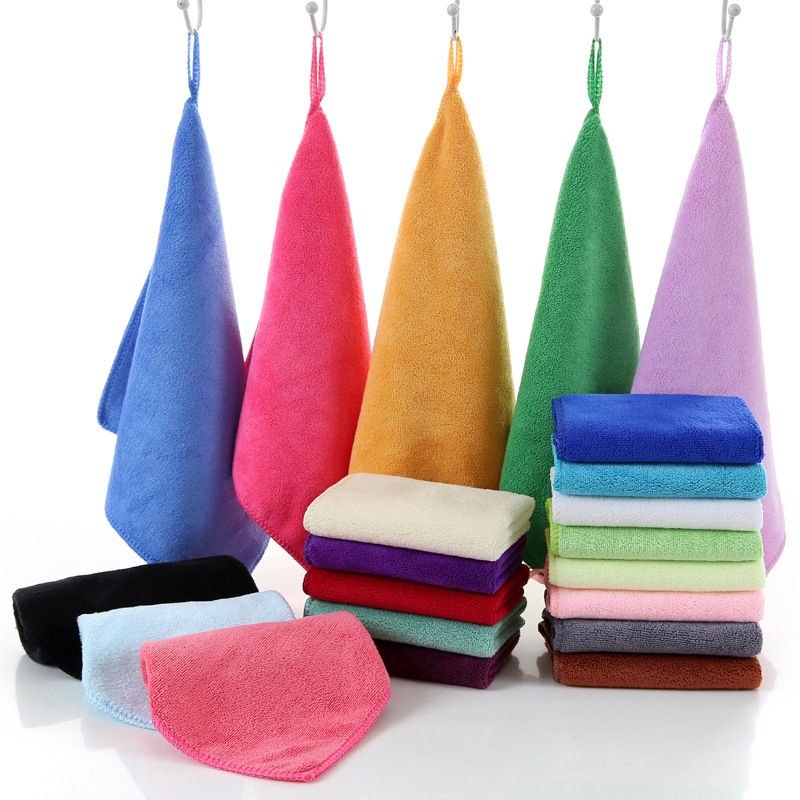
Water Absorption: Structure Is Not the Deciding Factor, Though It Affects Hand-Feel
A common misconception is that weft-knitted fabrics are inherently more absorbent than warp-knitted ones (or vice versa). In reality, the capillary effect of the fibers themselves is the primary driver of water absorption; the weaving method primarily influences the “tactile rhythm” of the absorption process.
The water-absorbing capacity of microfiber relies on the microscopic grooves formed on the fiber surface—created during the “fiber-splitting” process—as well as the capillary spaces between the fibers. When polyester-polyamide composite filaments undergo an alkali-treatment process, each fiber splits into multiple segments, drastically increasing the surface area. Water is drawn into the spaces between these segments via capillary action, rather than being absorbed into the fibers themselves. This mechanism applies equally to both warp-knitted and weft-knitted fabrics.
However, the loftier, bulkier structure of weft-knitted fabric offers a more pleasant user experience, especially when in contact with the skin. Weft-knitted towels feature looser loops, resulting in a “thicker” and “softer” feel. They conform more closely to surfaces during wiping, avoiding the stiff, “board-like” sensation sometimes found in certain warp-knitted towels. For applications like hair-drying towels, face towels, or cloths for cleaning car interiors—where the fabric must frequently conform to irregular surfaces or undergo repeated rubbing—the softness and loft of weft-knitted fabric provide a tangible advantage.
Regarding actual water-absorption rates, a 2025 evaluation of sports towels by the Consumer Council of Macau showed that microfiber sports towels achieved absorption rates ranging from 195% to 532%—an excellent performance. While the test did not distinguish between weaving methods, most sports and hair-drying towels on the market utilize a weft-knitted structure. Academic research also indicates that polyester filament knits (a category that includes weft-knits) generally offer better drying performance than woven towels, while lightweight warp-knitted towels also perform well in terms of both water absorption and drying speed.
In short: Weft-knitted towels are just as effective at absorbing water as warp-knitted ones, but they hold an edge in terms of tactile quality rather than raw absorption figures.
Dyeing and Finishing of Weft-Knitted Towels: A Crucial, Often Overlooked Process Step
There is a key difference in the finishing process between weft-knitted and warp-knitted fabrics, which directly impacts the quality of the final product.
The typical production process for weft-knitted towels involves shearing (cutting the loops) followed by heat-setting (stabilizing the fabric structure). Because weft-knitted fabrics are subjected to significant longitudinal tension during the weaving and dyeing processes, they tend to shrink in width, leading to dimensional instability. If such a fabric were heat-set before shearing, the tension applied during the shearing process would distort the fabric width, making it difficult to control the final dimensions. Consequently, weft-knitted towels are typically sheared first—trimming the surface loops to a uniform height—and then passed through a stenter (tenter frame) to stabilize their dimensions.
Warp-knitted towels, by contrast, feature a more stable structure with minimal dimensional change during shearing. They can be heat-set prior to shearing, which streamlines the production process and results in higher dimensional precision for the finished product.
This implies that the production of weft-knitted towels requires more precise control during the stages between shearing and heat-setting. If tension is not carefully managed during the heat-setting phase following shearing, it can lead to uneven pile height or diagonal distortion of the fabric. When purchasing, checking whether the loops are uniform and the fabric is square is essentially a way to evaluate the quality of the finishing process.
Selection and Usage
Check the edges. The edge finish (hemming or binding) of a weft-knitted towel is the primary defense against unraveling. Opt for towels with secure, tightly stitched hems, or those with ultrasonically sealed edges. If the edges are merely cut without any further treatment, the risk of the fabric unraveling increases significantly.
Consider the intended use. The softness and loft of weft-knitted towels make them ideal for direct contact with surfaces—such as for hair-drying towels, face towels, interior detailing, or drying vehicle paintwork. If you need a towel for cleaning glass without leaving streaks, or for wiping delicate mirror surfaces, a warp-knitted or waffle-weave towel might be more suitable; these structures are firmer and more effective at “scraping” water away. However, if your priority is “absorbing water while feeling soft to the touch,” a weft-knitted towel is the more natural choice.
Cleaning and Maintenance. The general care principles for microfiber towels apply equally to weft-knitted varieties: avoid fabric softeners, wash separately, and air-dry in the shade. The consequences of fabric softener clogging the gaps between fibers are particularly pronounced in weft-knitted towels. Their fluffy structure relies on the air and spaces between fibers to absorb water; once these are coated in a waxy film, the towel may still feel soft to the touch, but its water-absorbency will plummet. Furthermore, the looped structure of weft-knitted towels is relatively “loose,” making them prone to snagging if washed alongside hard items like zippers or Velcro—it is safer to wash them separately.
The value of a weft-knitted microfiber towel does not lie in it being “better” than a warp-knitted one, but rather in the softer, more conforming, and fluffier wiping experience it provides. By understanding its structural logic, you can quickly evaluate products on the shelf: a reliable towel will typically feature sturdy edges, a fluffy (yet not flimsy) feel, and the ability to remain supple even after washing.
Post time: Oct-16-2026