

A Guide to Avoiding Pitfalls with High-and-Low Pile Car Cleaning Towels: Not All Microfibers Deserve the Title of “Water-Absorbing Marvel”
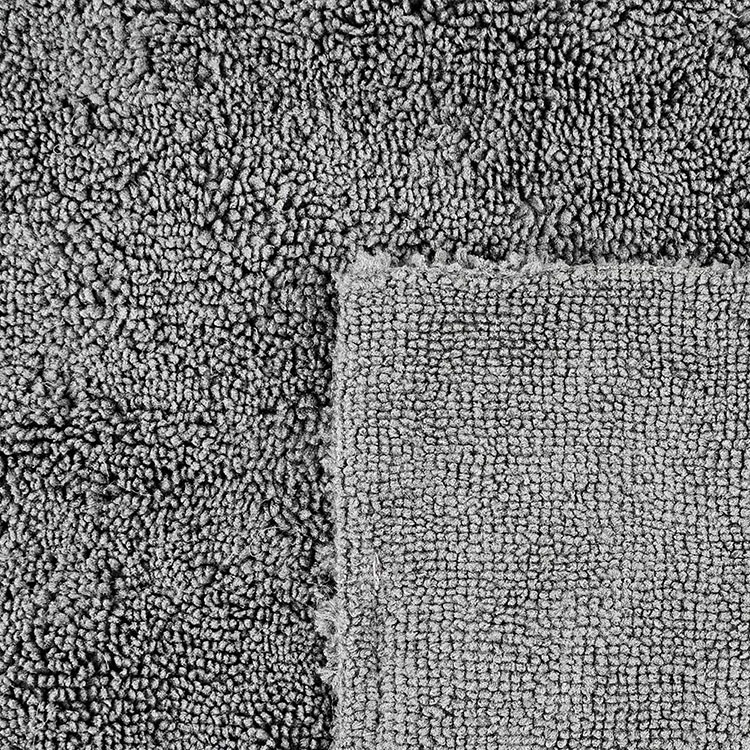
High-and-low pile car cleaning towels, seemingly ordinary car care tools, hold a lot of secrets for those in the know. Their design, with one side having long pile and the other short pile, isn’t arbitrary; it’s a precise division of labor for different car cleaning scenarios: the long pile side absorbs and retains water, while the short pile side specializes in polishing and waxing—one towel handles two core steps.
Material and Manufacturing Process: The Secrets of Microfiber
Most high-and-low pile car cleaning towels on the market are made of 80% polyester and 20% nylon microfiber. Basis weight (GSM) is a key indicator of thickness and absorbency, commonly found in specifications like 380GSM and 400GSM. The higher the number, the thicker the fabric and the stronger the absorbency.
The water absorption principle of microfiber isn’t “absorption,” but rather “adsorption”—the gaps between the fibers create a capillary effect, quickly “absorbing” water droplets into the towel. A good car cleaning towel can absorb 6-10 times its own weight in water, several times more than a regular towel. One car owner, after testing it, exclaimed, “One towel can absorb several times its own weight in water; the car isn’t dripping wet after a wash!”
In terms of details, PE material edging or ultrasonic edge cutting are used to prevent scratches on the paint, which is especially important for owners of dark-colored cars.
The Logic of High-Pile and Low-Pile Functions: The essence of high-pile and low-pile car cleaning towels lies in their “two-in-one” design:
Long Pile Side (Side A): This side has a longer, softer feel and is primarily responsible for absorbing and retaining water. After washing the car, gently dragging it across the body removes the water film instantly, leaving no watermarks. The long pile structure also absorbs dust particles, reducing the risk of friction against the paint.
Short Pile Side (Side B): This side has a shorter, denser pile, providing moderate friction, suitable for waxing, polishing, and cleaning the interior. After waxing, use it to collect the wax or wipe the glass and dashboard, leaving no lint residue.
One user shared their experience: “The long-pile side gently absorbs moisture, while the short-pile side precisely handles corners and crevices, even covering the corners of rearview mirrors.”
Selection Tips and Precautions:
Consider Weight and Size: Higher weight means thicker and more absorbent, but it also dries slower. 40×40cm is suitable for daily water absorption, while 40×60cm or larger sizes are suitable for quick wiping of large areas.
Consider Edge Finishing: Prioritize products with soft PE edges or finely finished edges to avoid scratching the paint.
Actual User Reviews: Most users appreciate its absorbency and lint-free properties, but some feedback mentions lint shedding in some lower-priced products. It’s recommended to choose reputable brands.
Usage and Maintenance: For first-time use, wash with water to remove loose lint; wash promptly after use, do not use fabric softener (it will clog fiber gaps and affect absorbency), and allow to air dry naturally.
Summary: High-low pile car towels are not simply two types of towels sewn together, but rather utilize fiber technology and weaving processes to allow one towel to perform different functions in different scenarios. For car enthusiasts, it’s a cleaning tool that understands car paint better than a regular towel; for ordinary car owners, it makes washing and drying the car easier and more reassuring. It doesn’t make a fuss, but every time it wipes a spot, it looks like its shine has been recalibrated—that’s probably what a good tool should be like.
Post time: Sep-03-2026