
Avoid “Swirl Marks” That Ruin Your Car’s Finish: Why Do Car Enthusiasts Use “Twisted-Loop” Towels?
After washing your beloved car, do you simply grab an old undershirt or that stiff, free promotional towel?
If you look closely at your car’s paintwork, you might notice “swirl marks” and spiral scratches visible in the sunlight. These aren’t caused by road debris; they are actually “permanent kisses” left behind by that seemingly harmless drying cloth.
For true car enthusiasts, the final step of washing—**drying**—is the make-or-break moment for paint gloss. The “paint-protecting miracle” currently acclaimed in the auto-detailing world is exactly what we’re discussing today: the **twisted-loop microfiber drying towel**.
## The Core Issue: Your Towel Is “Sanding” Your Paint
Many car owners hold a common misconception: that only pure cotton is soft and absorbent. The reality is quite the opposite.
1. The Flaw of Pure Cotton: While pure cotton is soft when dry, its fibers swell and stiffen when wet, and the surface lacks a structure to trap dust effectively. If tiny sand particles get trapped in the towel, wiping the car becomes akin to dragging sandpaper across the paintwork.
2. The Shedding Problem of Cheap Synthetic Fibers: Low-quality synthetic towels often have weak fibers that shed fine lint onto the car body—something particularly noticeable on dark-colored vehicles.
The twisted-loop drying towel was created to solve this seemingly contradictory challenge: achieving high absorbency, zero scratches, and no lint shedding all at once.
Decoding the “High-Tech” Feature: What Is the Twisted-Loop Structure?
The core advantage of this drying towel lies in its unique physical structure.
Twisting Process: Ordinary fibers are straight and tend to collapse when wet. “Twisting,” however, involves spirally winding multiple strands of microfiber together, much like a rope. This not only significantly enhances the fiber’s toughness but also creates a “capillary effect” within the gaps between fibers, enabling active moisture wicking and absorption rather than passive wiping.
- “Little Braid” Loops: Unlike the flat loops found on ordinary towels, the surface of this towel is covered in fluffy, three-dimensional, “braid-like” loops. This design offers three brilliant advantages:
- Suspended Wiping: The raised “braids” act like countless soft, tiny tentacles; they make initial contact with the paintwork while the towel’s base fabric remains suspended, drastically reducing both the friction area and the force applied.
- Dirt Trapping: Micro-dust and grit are drawn into the gaps between the “braids” rather than getting stuck on the surface and grinding against the paint, effectively providing a physical barrier against scratches.
- Enhanced Drying: The 3D structure increases the surface area exposed to air, allowing moisture to evaporate more quickly so the surface dries immediately after wiping.
Material is King: The 80/20 Ratio—The Golden Rule for Absorption and Paint Protection
Even the best design requires high-quality materials. Professional twisted-loop “braid” towels typically utilize a “golden ratio” of **80% polyester and 20% polyamide (nylon)**.
- Polyester: Responsible for “absorption.” Its fibers feature a multi-lobed cross-section with a massive surface area, allowing it to capture water molecules incredibly fast.
- Polyamide (Nylon): Responsible for “protection.” It imparts excellent elasticity and abrasion resistance to the fibers, ensuring the “braids” remain fluffy and upright—resisting matting or stiffening—even after repeated washing and scrubbing.
The immediate result of this combination is that as the towel glides over the car’s paint, water marks are instantly “wicked away”; there is no need for repeated wiping, leaving behind nothing but a mirror-like, glossy finish.
Real-World Performance: What Makes a Towel Superior
In actual use, the experience of using a twisted-loop “braid” towel is vastly superior:
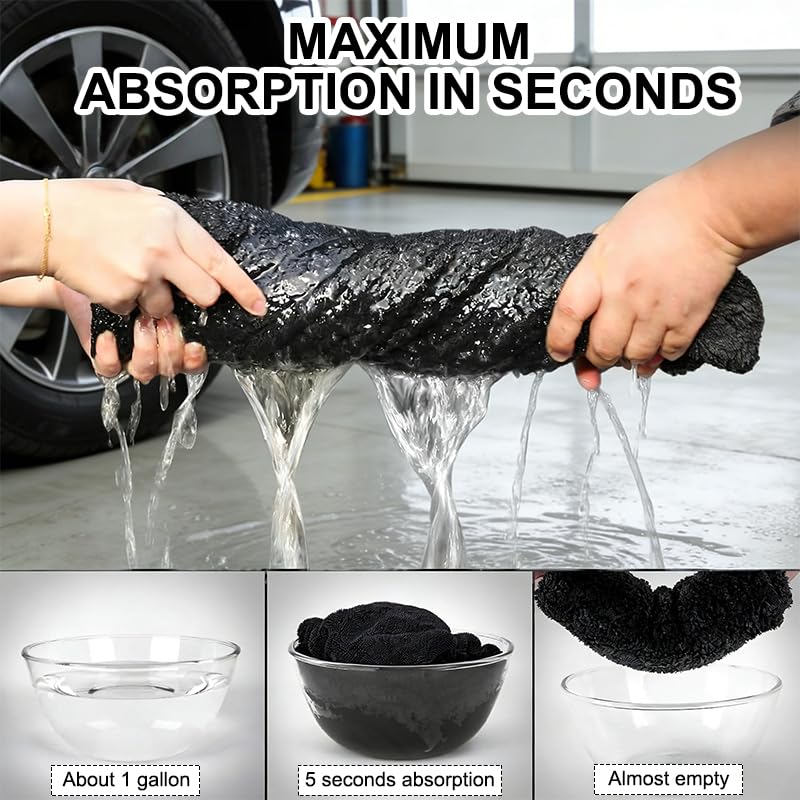
- Effortless Use: Thanks to its exceptional absorbency, the towel simply needs to touch the paintwork, and moisture is automatically drawn in. When drying SUVs or large vehicles, conventional methods require wringing out the towel repeatedly; with this towel, a single pass is usually all it takes to dry the surface, more than doubling your efficiency.
- Versatile Use: Beyond the car’s paintwork, it is also excellent for glass. Because it is lint-free, it leaves the windshield crystal clear and streak-free, ensuring better visibility when driving in the rain.
- Care Instructions: To maintain its superior absorbency, **never use fabric softener** during washing! Fabric softener clogs the fiber micropores, turning the “microfiber loops” into matted, ineffective clumps. Simply use a neutral detergent and air dry.
Buying Guide: Choose the Right Size for Best Results
- Daily Car Wash (60x90cm): Ideal for large areas like the roof and hood; the size is just right for easy, one-handed wringing.
- Professional-Grade Care (60x160cm or larger): A standard choice for high-end detailing shops. Its large size allows it to be laid flat across the roof or hood; by using gravity and a single drag, you can dry the entire paint surface with “zero friction.”
Conclusion
The luster of your car’s paint depends not only on wax or ceramic coatings but also on the details of every drying session. Say goodbye to that old undershirt you’ve used for years and switch to a professional-grade twisted-loop drying towel. You’ll discover that your car’s paint can feel incredibly smooth, and washing your car becomes a truly enjoyable experience.
Post time: Jun-22-2026