

Car Waxing “Innovative Technology”: Self-Care with a Composite Car Waxing Towel
The act of washing a car may seem simple, but it actually involves hidden complexities. Some people work hard with ordinary towels for a long time, but when viewed under the sunlight – water stains are everywhere, and upon closer inspection, there are fibers of lint adhering to the paint surface. The entire car seems to be covered with a layer of dust. In fact, the problem often does not lie in the strength of the hand, but in the tool. The emergence of the composite car waxing towel is precisely to solve the three major problems of “not able to clean thoroughly, leaving water marks, and easy to shed fibers”.
What is a composite car waxing towel?
In simple terms, a composite car waxing towel is not a single material, but combines two or more functional fibers into one. Common combinations include a super fine fiber layer and a microporous sponge layer, or a front suede fabric and a back coral fiber layer.
This structural design is not a simple superimposition, but each part performs its own function. Taking the typical double-layer composite towel as an example: one side is responsible for strong water absorption, and the other side is responsible for polishing and removing stains. One wipe completes two processes. Some high-end products even use a three-layer structure – the upper and lower layers are melt-blown fibers, and the middle layer includes wood pulp fiber and spunbond long fiber layers, which prevent fiber shedding while improving durability.
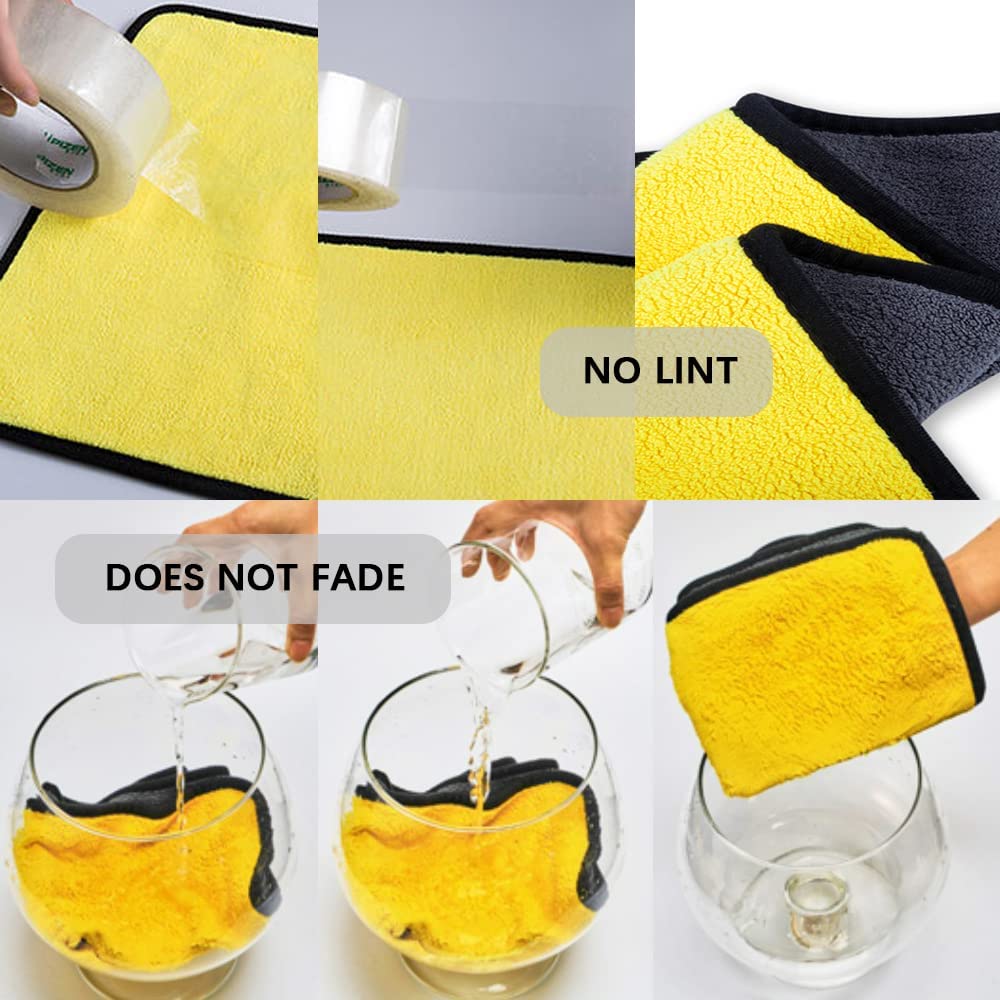
Core material: The “capillary attraction” of ultra-fine fibers
The performance foundation of the composite car waxing towel lies in ultra-fine fibers. These fibers have a diameter less than 1/200 of a hair, and are made of polyester and nylon composites. It does not rely on chemical cleaners, but achieves cleaning through physical structure:
Capillary effect: The cross-section of the fiber is in the shape of a cross or Y, forming a large number of micrometer-level grooves. When in contact with water stains, the capillary effect is like countless small suction cups, instantly drawing the water into the fiber gaps and locking it, rather than floating on the surface and dragging back and forth.
Strong adsorption: Under the same weight, the contact area of ultra-fine fibers is several times larger than that of ordinary fibers, and can adsorb 7 times the weight of dust and liquids.
This means that when waxing the car, a gentle press and drag will cause the water to be sucked away instantly, without the need for repeated forceful wiping, and naturally, the paint is not damaged.
How to choose a reliable composite car waxing towel?
Three points are enough:
Look at the weight: High weight (such as 500 grams per square meter) means the fabric is thicker and the fibers are more dense, with better water absorption and durability.
Look at the edge: Products with solid edges and no loose threads are more durable and will not disperse edges and fibers during the wiping process.
Look at the craftsmanship: Products using hot melt adhesive for composite rather than oily glue have a softer feel and are environmentally friendly without any unpleasant odor. Avoid using cleaning agents containing bleach or fabric softeners, as they may damage the fiber structure. Summary
The underlying principle of the composite car cleaning towel is quite simple: Use the right material in the right situation. It doesn’t rely on brute force; instead, it uses the physical structure of technological fibers to “absorb” water stains and dust. For car owners, it is not only a cleaning tool but also a hidden helper for protecting the car paint – ensuring that the car body always presents a neat and tidy “appearance” after each wash.
Post time: Aug-14-2026