

Choosing the right drying towel is half the battle in car care: Unveiling the appeal of weft-knitted microfiber towels.
For car enthusiasts, washing a vehicle is far more than a mere physical chore; it is a ritual dedicated to preserving the car’s appearance. Those unsightly swirl marks, lingering water streaks, and stubborn puddles left behind after wiping often stem from a seemingly insignificant tool: the drying towel. If you are still using old household cotton towels to dry your car, it is akin to sanding the paintwork. Today, the professional choice recognized within the car care community is the weft-knitted microfiber towel.
What exactly is a “weft-knitted” drying towel, and how does it differ from an ordinary towel?
To appreciate the merits of a weft-knitted drying towel, one must first understand its “origins.” Towel weaving methods generally fall into two categories: warp knitting and weft knitting. Weft knitting involves feeding one or more yarns into the working needles of a knitting machine in the weft direction, where the yarns are sequentially bent into loops and interlocked to form the fabric.
This process imbues weft-knitted drying towels with unique advantages. Compared to common warp-knitted towels, weft-knitted fabrics feel softer, thicker, and more elastic. When wiping the car body, the towel conforms closely to the microscopic contours of the paint surface—unlike stiffer towels that merely “float” on top—thereby effectively minimizing physical friction damage to the paint. Simply put, the weft-knitting process gives the towel an inherent “gentleness.”
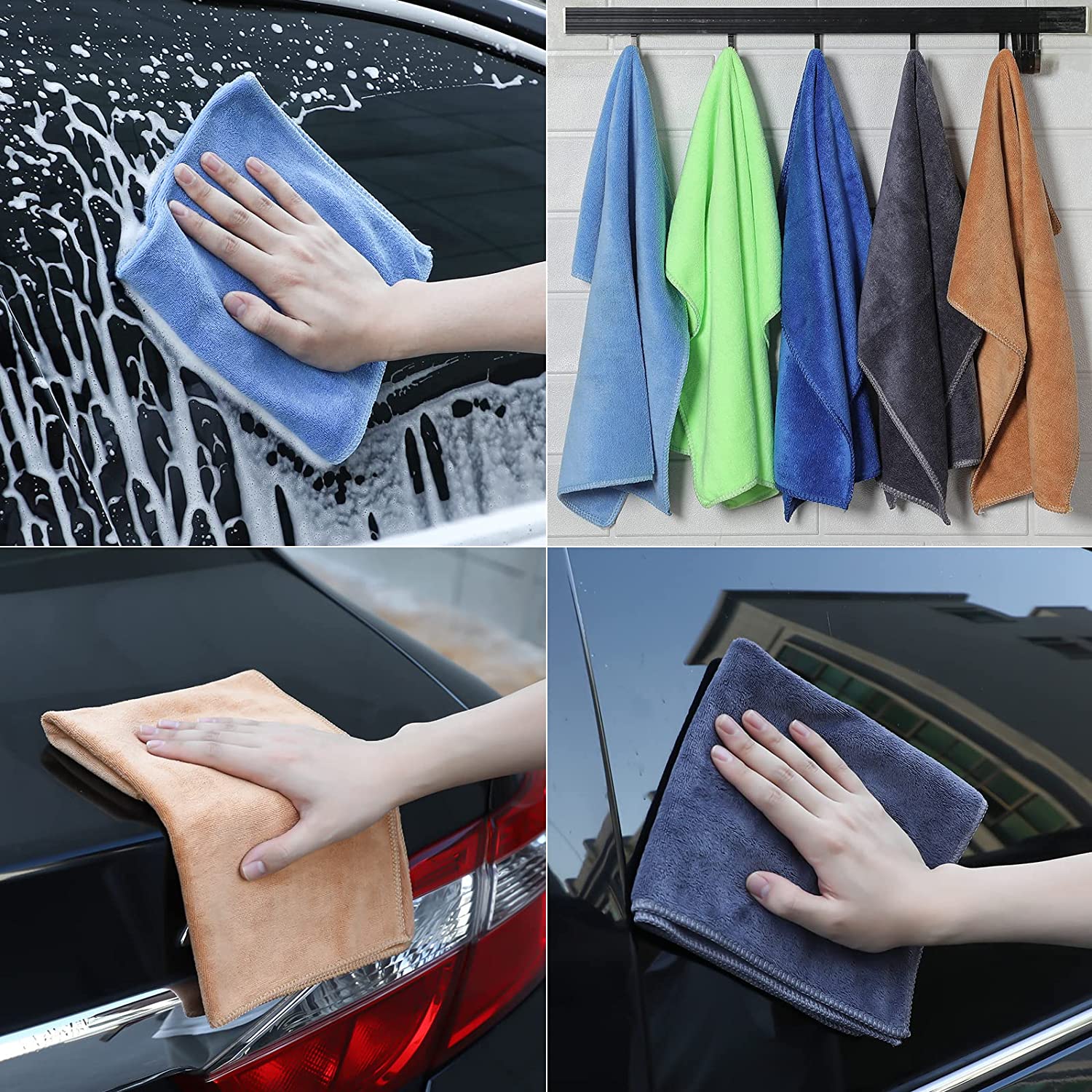
Core Technology: The “Orange-Slice” Secret of Microfiber
If the weft-knitting process defines the towel’s “physique,” then the microfiber material provides its true “soul.” High-quality weft-knitted drying towels on the market are typically made from a composite microfiber blend of 80% polyester and 20% polyamide (nylon).
Just how remarkable is this fiber? Its fineness is merely one-tenth that of silk, or even just one-two-hundredth the thickness of a human hair. Crucially, this fiber utilizes “orange-slice” technology, splitting a single filament into multiple segments to exponentially increase the surface area in contact with air. This yields three immediate benefits:
Instant water absorption, no streaks: The expanded surface area, combined with the fabric’s abundant pores, creates a powerful capillary wicking effect. It rapidly absorbs moisture weighing several times its own mass; a single light pass leaves the car body instantly dry, eliminating the hassle of repeated wiping.
Deep cleaning, efficient dirt removal: Acting like countless tiny brushes, the ultra-fine fibers penetrate the microscopic pores of the car’s paintwork to efficiently capture and remove stubborn grime and dust particles as small as a few microns. Its cleaning power far surpasses that of ordinary cotton towels.
Lint-free performance: Ordinary cotton towels tend to shed fibers after prolonged use, often leaving behind a layer of tiny lint. In contrast, these high-strength synthetic microfiber filaments are resistant to breakage and shedding. Furthermore, the tight weft-knitted structure prevents fibers from detaching, ensuring a residue-free finish that leaves the paintwork looking brand new.
A versatile all-rounder: From washing to waxing
With this powerful tool at hand, many aspects of car care become far more efficient.
Drying after a wash: This is the towel’s fundamental strength. Whether on the bodywork, glass, or side mirrors, it dries surfaces in a single pass, preventing water droplets from drying into stubborn limescale spots.
Waxing and polishing: After applying car wax, use a clean weft-knitted towel to buff the surface. Its soft texture ensures even application and adhesion, effortlessly achieving a mirror-like shine without damaging the paint.
Interior and screen cleaning: Use it dry on dashboards, LCD screens, and leather seats; its powerful electrostatic attraction effectively captures dust without scratching delicate surfaces.
Maintenance tips: Making it last longer
A tool this effective deserves proper care. When cleaning microfiber car towels, plain water or a small amount of neutral detergent is all you need, as dirt tends to adhere between the fibers rather than penetrating deep inside them. Crucially, never wash them together with pure cotton towels; otherwise, lint shed by the cotton will stick to the microfiber and impair its performance, potentially leading you to mistakenly believe the microfiber towel itself is shedding. Also, avoid using fabric softeners, as they can clog the gaps between fibers and reduce water absorbency.
Conclusion
Say goodbye to traditional towels that can damage your vehicle’s finish and opt for a professional weft-knitted microfiber car towel—a highly cost-effective investment in your car’s care. The efficiency, safety, and superior cleaning results it delivers will transform car washing from a chore into a genuinely enjoyable experience. Next time you wash your car, take a closer look at the tools you are using; upgrading your towel might just be the key step to enhancing your vehicle’s appearance.
Post time: Jun-26-2026