

Dual-Pile Car Towels: A “Breathable” Surface for Your Car’s Finish
Car enthusiasts often say, “Car paint is like skin.” During routine maintenance, the items that come into direct contact with the paintwork—aside from the wash sponge—are those seemingly humble towels. Choosing the wrong one can lead to issues ranging from water spots and lint residue to the dreaded “swirl marks” (or “spider webbing”) that appear under direct light—a heartbreaking sight for any car lover.
In recent years, a type of car towel featuring a “dual-pile” (high-low pile) design has quietly gained popularity in the detailing community. What makes it so special, and how should you choose one? Let’s take a closer look.
High Pile and Low Pile: Smart Functionality
Standard towels have uniform fiber lengths; they saturate quickly when absorbing water and often fail to conform well to tight corners or edges. In contrast, dual-pile towels are created using a warp-knitting process: one side features a fluffy, high-pile (long loop) texture, while the other has a dense, low-pile (short loop) texture. Each side serves a specific purpose.
The High-Pile Side: Designed for “Thirsty” Work. The thickened, long-pile microfiber is incredibly absorbent, capable of holding several times its own weight in water. After washing your car, gently gliding this side over the paintwork “wicks away” the water film instantly rather than “scraping” it off, making it extremely gentle on the finish.
The Low-Pile Side: Expert at “Precision Detailing.” Stubborn water spots in body panel gaps, around side mirrors, or inside door handles can be tackled with this side using moderate pressure. It removes water precisely without the risk of long fibers snagging or distorting.
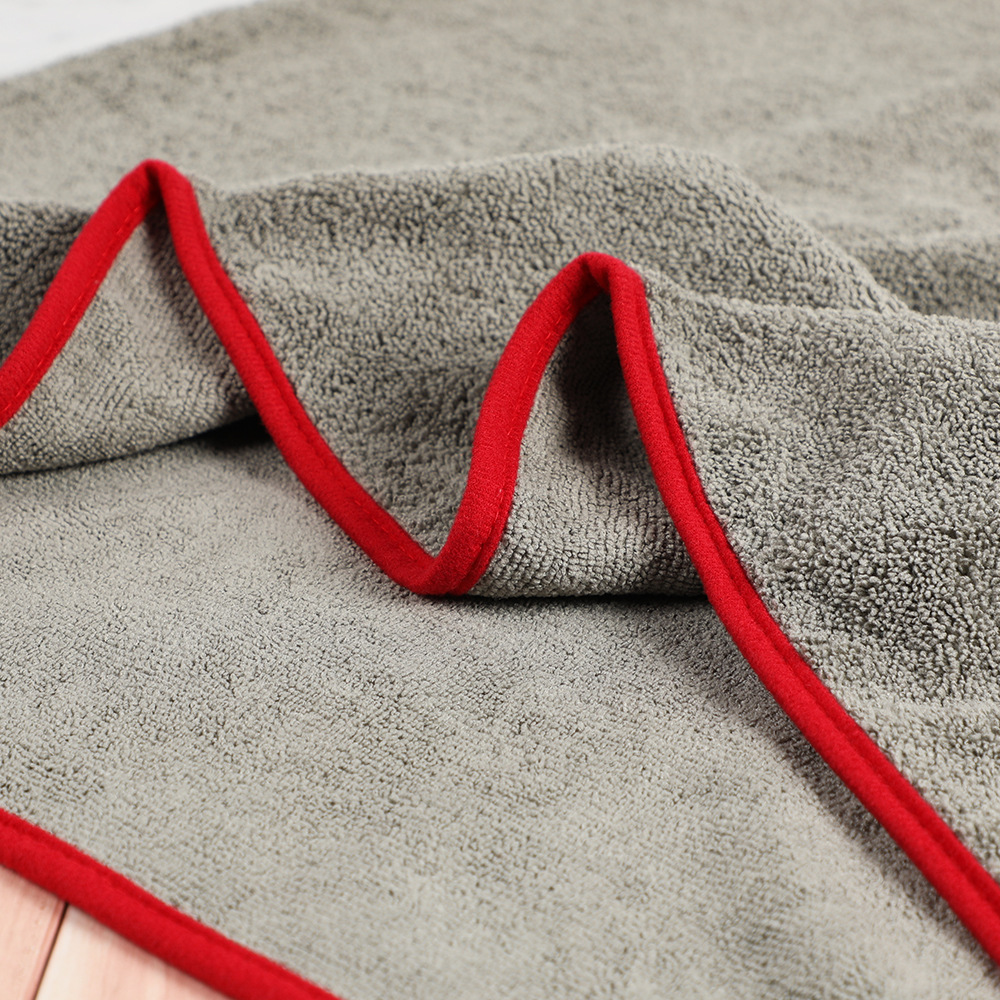
This design allows a single towel to handle both large-area drying and intricate detailing, making it incredibly convenient to use.
Why Choose Microfiber for Car Drying?
Material determines both safety and performance. Unlike pure cotton towels—which have coarse fibers, shed lint easily, and can act like sandpaper once they trap dust—professional car towels typically utilize a microfiber blend of 80% polyester and 20% polyamide. These fibers have an extremely small diameter, allowing them to reach deep into microscopic crevices for thorough cleaning without scratching the car’s paintwork. Crucially, the use of laser or ultrasonic heat-sealing for the edges significantly reduces linting and shedding.
**Tips for Selection and Maintenance**
When shopping, look for labels indicating “dual-pile” (high-low pile) and “microfiber” construction, and pay attention to two key specifications:
**Weight (GSM):** Opt for a thicker towel with a rating of 300 GSM or higher; a higher fiber density per unit area translates to superior water absorption and surface protection. Some premium products even reach 380–470 GSM.
**Edge Finishing:** Prioritize products with laser-cut or ultrasonic-sealed edges. These smooth, seamless edges minimize the risk of scratching the paint.
**Care Instructions:** It is normal for new towels to shed a small amount of loose lint during the first use. Do not use fabric softener when washing, as it clogs fiber pores and drastically reduces absorbency. High-temperature tumble drying is also not recommended; air drying is sufficient.
Ultimately, the value of a dual-pile car towel lies in its smart design, which makes the task of washing your car effortless and worry-free. It is not merely a disposable item, but a soft, protective barrier that preserves the luster of your car’s paintwork.
Post time: Jun-30-2026