

Edged Car Drying Towels: How a Simple Edge Design Determines the Safety of Your Paintwork
When it comes to car washing, people often focus on the soap, water pressure, or waxing, while overlooking the final drying step. Those fine “swirl marks” (or “spiderwebbing”) on the paint are almost certainly caused during the drying process. Ironically, the most inconspicuous part of the towel—the edge—is often the culprit behind these scratches.
Why “Edging” Is a Key Factor When Choosing a Drying Towel
Many cheap towels on the market use standard stitching or even stiff plastic thread for their borders. When wet, these hard edges rub repeatedly against the paintwork. Especially when wiping large, flat areas like the hood or roof—which require some pressure—coarse, stiff stitching acts like a dull blade, leaving irreparable fine scratches on the clear coat.
Edging technology solves this problem. Mainstream mid-to-high-end towels typically feature satin or microfiber edging that completely encases the raw cut edge, ensuring that every inch of fabric touching the paint remains soft. Some top-tier products even use a “borderless” design, eliminating the risk of edge-induced scratches entirely by using a special weave that allows the fabric edge to finish naturally.
Key Standards for a Quality Edged Drying Towel
Material composition is the foundation. Professional towels generally use a blend of 80% polyester and 20% polyamide. Polyester provides structural integrity and durability, while polyamide enhances absorbency and softness. Products made of 100% polyester suffer from poor absorbency and a stiff feel; they are not recommended.
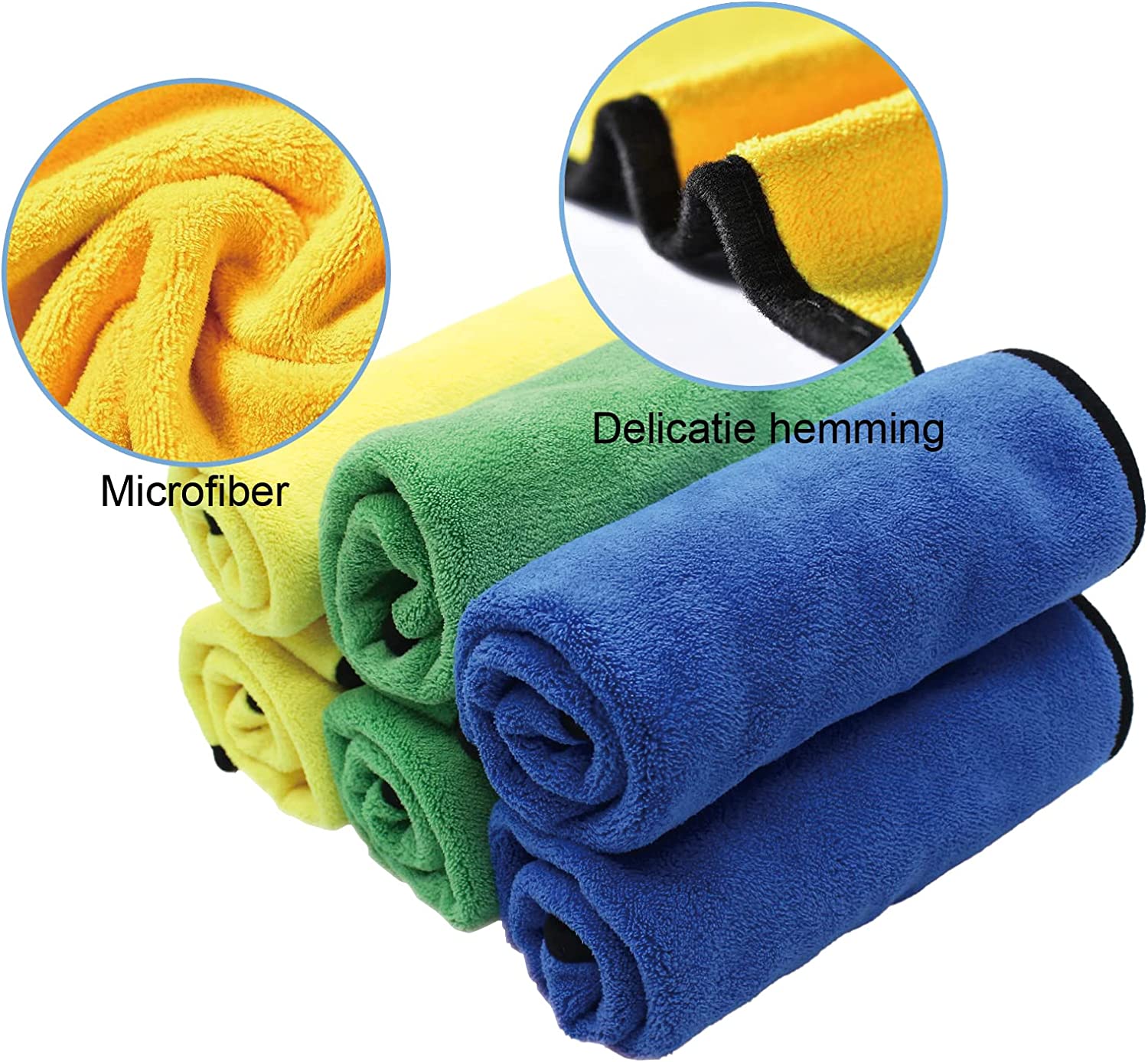
Weight determines performance. GSM (grams per square meter) directly indicates the towel’s thickness and absorbency. 300 GSM is entry-level, suitable for interior cleaning or final touch-ups. 600 GSM is the mainstream standard; it is highly absorbent, and a single towel is usually sufficient for a mid-sized sedan. Meanwhile, “monster-class” 1200 GSM products can dry an entire vehicle with just one towel—ideal for users who prioritize efficiency.
Edging quality is visible to the naked eye. First, examine the edge stitching: high-quality edging should be smooth, fine, and free of raised ridges. If it feels rough, gritty, or stiff to the touch, skip it. Run your fingernail along the edge; if it catches or feels abrasive, the towel is substandard.
How to use an edged drying towel correctly:
Use separate towels for different areas. Ideally, keep dedicated towels for the car body paint, glass, and wheels. Wheels accumulate brake dust and metal shavings; if a towel used on wheels contaminates the paintwork towel, even the softest edging won’t save your paint from scratches.
“Drag” to dry; don’t “scrub.” After washing, lay the towel flat on the wet paint surface and gently drag it using the palm of your hand, allowing the fibers to naturally absorb the water rather than scrubbing back and forth vigorously. A single 600 GSM edged towel (approximately 40×60 cm) is sufficient to dry a compact car.
Proper cleaning is essential. Never use fabric softener on drying towels; it clogs the fiber pores, causing the towel to lose absorbency over time. Wash with a neutral detergent in cold water (by machine or hand) and air dry in the shade. If you notice a significant drop in absorbency, soaking the towel in warm water with a small amount of degreaser can help restore it.
An edged drying towel isn’t a high-tech product, but the quality of that edge determines whether you are protecting your car’s paint or abrading it. Spending an extra ten or twenty yuan on a towel with high-quality edging can save you hundreds in future paint polishing and repair costs.
Post time: Sep-22-2026