

Laser-Cut Coral Fleece Car-Drying Towels: Why an “Edgeless” Design Is Key to Paint Protection
When drying a vehicle after a wash, the stiff, stitched edges of a towel are often the biggest concern. Many car owners have had this experience: after wiping down the car, they notice fine, hair-like scratches appearing under the sunlight. The problem usually lies not in the main surface of the towel, but along its edges. Laser-cut (or “edgeless”) coral fleece towels are highly regarded in the automotive detailing community precisely because of this “cut-edge” feature—it eliminates the very part of a traditional towel most likely to damage the paint.
The Laser-Cutting Process: Eliminating “Hard Edges” at the Source
Traditional towels often feature stitched or serged borders, which create a raised, rigid ridge. During wiping, this ridge bears significantly more pressure than the soft, plush surface; if any tiny sand particles become trapped there, the rigid edge effectively acts as a scraper against the paint. In contrast, ultrasonic laser-cutting uses high-frequency vibrations to instantly fuse and sever the microfiber fabric. This results in a clean, neat edge—free of stitching or raised seams—that remains soft to the touch. For modern automotive clear coats, which are often extremely thin, this “seamless” edge significantly reduces the risk of inducing secondary scratches. Detailing experts have noted that long-pile towels can sometimes snag on emblems or chrome trim; once the fibers snag and harden, they can damage the paint. An edgeless, laser-cut design completely avoids the risks posed by stiff, stitched borders.
The Advantages of Long-Pile Coral Fleece and Its Functional Scope
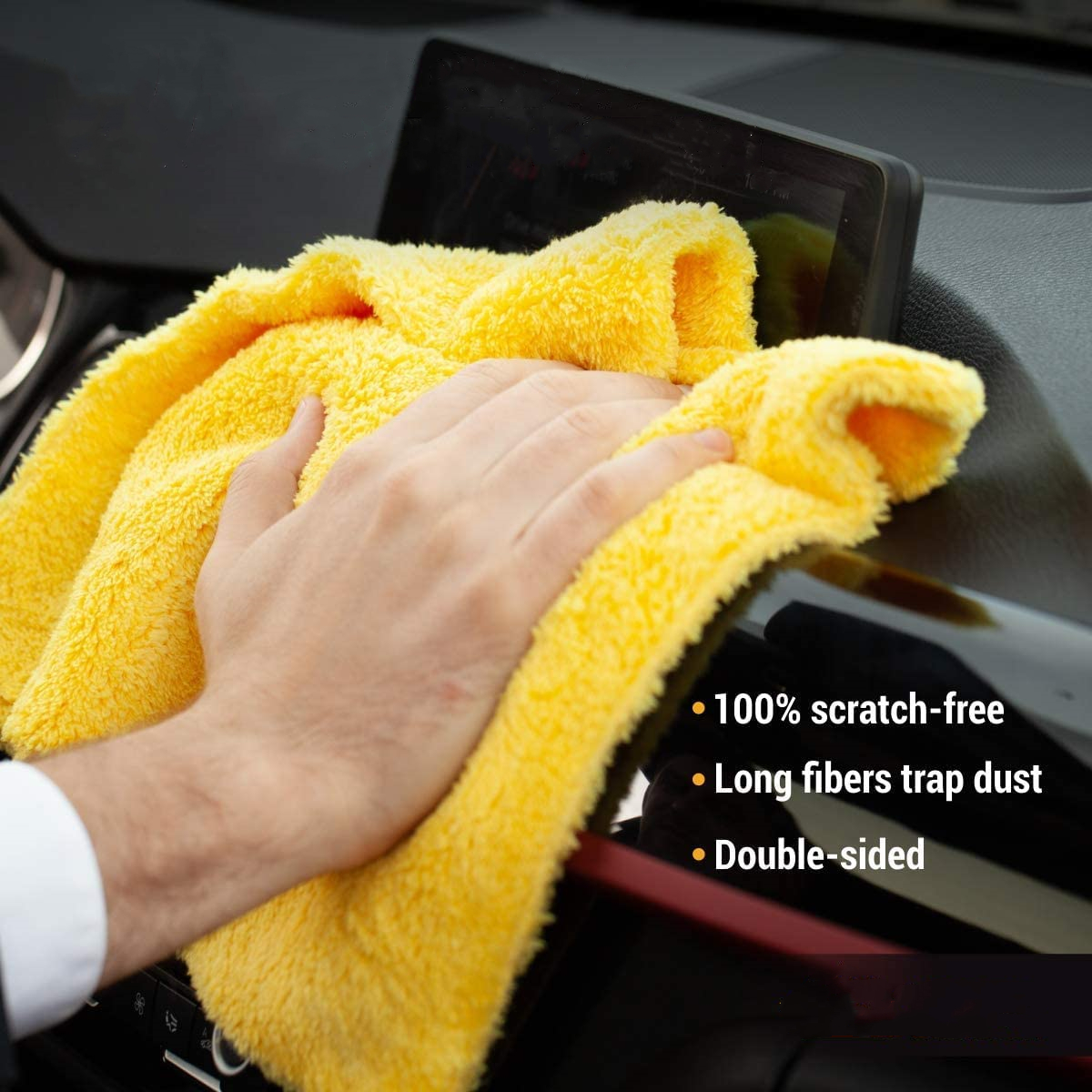
While the laser-cut design addresses edge-related issues, the coral fleece material itself excels at water absorption and dust/dirt containment. Through a process called “splitting,” individual microfiber strands are divided into dozens of finer micro-filaments, allowing the towel to absorb several times its own weight in water. The long, plush fibers of the coral fleece create a voluminous structure with ample space; as you dry the vehicle, water is rapidly trapped within the pile. Simultaneously, the fibers can sequester small amounts of grit or sand, minimizing the chance that these particles will be pressed directly against the paint surface during the wiping process. Commonly available edgeless coral fleece car-drying towels typically have a fabric weight (GSM) between 400 and 600. They are usually composed of a blend of 80% polyester and 20% polyamide, with 40×40cm or 40×60cm being the most standard sizes.
However, long-pile towels have specific limitations. While excellent for drying large exterior surfaces or cleaning vehicle interiors, they are not ideal for glass—the fibers tend to leave behind tiny lint particles. They should also not be used for vigorous scrubbing; the correct technique is to lay the towel flat on the paint surface and gently drag it across. For tasks like cleaning glass or reaching into the intricate crevices of a dashboard, a short-pile or waffle-weave towel is a better, safer choice.
How to Choose and Use
When selecting an edgeless coral fleece towel, first examine the edges. A high-quality ultrasonic-cut edge should be smooth, fray-free, and soft—feeling consistent with the rest of the towel’s surface even when folded. Next, check the GSM; 400 GSM is the minimum acceptable standard, while 500–600 GSM offers a substantial feel and maintains its loft even when saturated, making a single towel sufficient to dry an entire vehicle. Opt for darker colors or dual-tone designs; light-colored towels show dirt quickly, which can make it difficult to accurately gauge their condition.
Before the first use, rinse the towel to remove any loose, residual fibers. When drying your car, work from the roof downward. If the towel becomes dirty, rinse it in a bucket and wring it out before continuing. Never use the same towel for both the roof and the wheels—if iron particles or grit from the wheels become embedded in the fibers, the towel will effectively turn into sandpaper when used on your paintwork. After use, thoroughly rinse the base of the fibers and air-dry the towel away from direct, harsh sunlight to prevent the pile from becoming stiff or matted.
The lifespan of an edgeless coral fleece towel largely depends on how well you care for its edges. If the edges snag on a hard object—causing fibers to pull loose—or if they begin to curl and harden after washing, it is time to demote the towel to wheel-cleaning duties. While these towels are inexpensive, using them correctly can make the drying process significantly easier and more efficient.
Post time: Nov-11-2026