

Microfiber Weft-Knitted Towels: The “Hidden Champion” of Cleaning and Skin-Friendly Experience
In the subtle details of daily life, often hidden are quality upgrades we overlook. While you’re still troubled by ordinary towels shedding lint, slow water absorption, and becoming stiff and smelly after drying, a new type of fabric called “microfiber weft-knitted towels” is quietly changing the way hotels clean, car detailing, personal care, and even high-tech precision instruments are wiped.
Unlike traditional pure cotton towels with a long history, it has become an indispensable functional product in the modern textile industry thanks to its superior physical properties and ultimate tactile feel.
What is Weft Knitting? A More “Flexible” Weaving Philosophy
To understand the uniqueness of this towel, you first need to understand its skeleton—the weft knitting process.
Unlike warp knitting, which requires multiple yarns to simultaneously form loops longitudinally and has a stable structure that is difficult to tear, weft knitting refers to forming loops sequentially along the transverse (weft direction) of the fabric using one or more yarns. This weaving method gives towels two core characteristics:
Excellent lateral elasticity: Weft-knitted towels are softer and fluffier to the touch, and have significant lateral stretch. This means they conform better to surfaces when wiping the body or curved car bodies.
Unraveling capability: Theoretically, weft-knitted towels can be unraveled from the edges. While this means they are prone to unraveling along the loops if damaged, it also demonstrates the flexibility of its weaving structure, enabling designs with high weight and thickness.
Simply put, weft knitting gives towels both a cloud-like softness and a highly efficient cleaning geometry.
Core Technology: Not just fine, but a structural revolution
If weft knitting is the skeleton, then microfiber is its soul.
Standard microfiber is typically composed of 80% polyester and 20% nylon. Its diameter is only 1/10 that of silk, or even 1/200th the diameter of a human hair. These incredibly fine fibers, splitting using an “orange segment” technique, create countless tiny pores and sharp edges within a single yarn.
Capillary wicking effect: The micropores between the fibers create a powerful capillary action. This not only allows for the instant absorption of several times its own weight in water but also rapidly diffuses the water to the towel surface for evaporation, achieving a “easy wash, quick dry” effect and effectively inhibiting bacterial growth.
Physical adsorption for stain removal: Ordinary cotton fibers are round and rely on rolling to remove water stains; while microfibers are wedge-shaped, and their high-density edges can penetrate into tiny crevices like a scraper, capturing dust and oil stains as small as a few micrometers without easily damaging the surface.
High-end craftsmanship: The evolution from “terry loops” to “brushed finish” The weft-knitted towels we commonly see on the market offer drastically different experiences depending on the surface treatment:
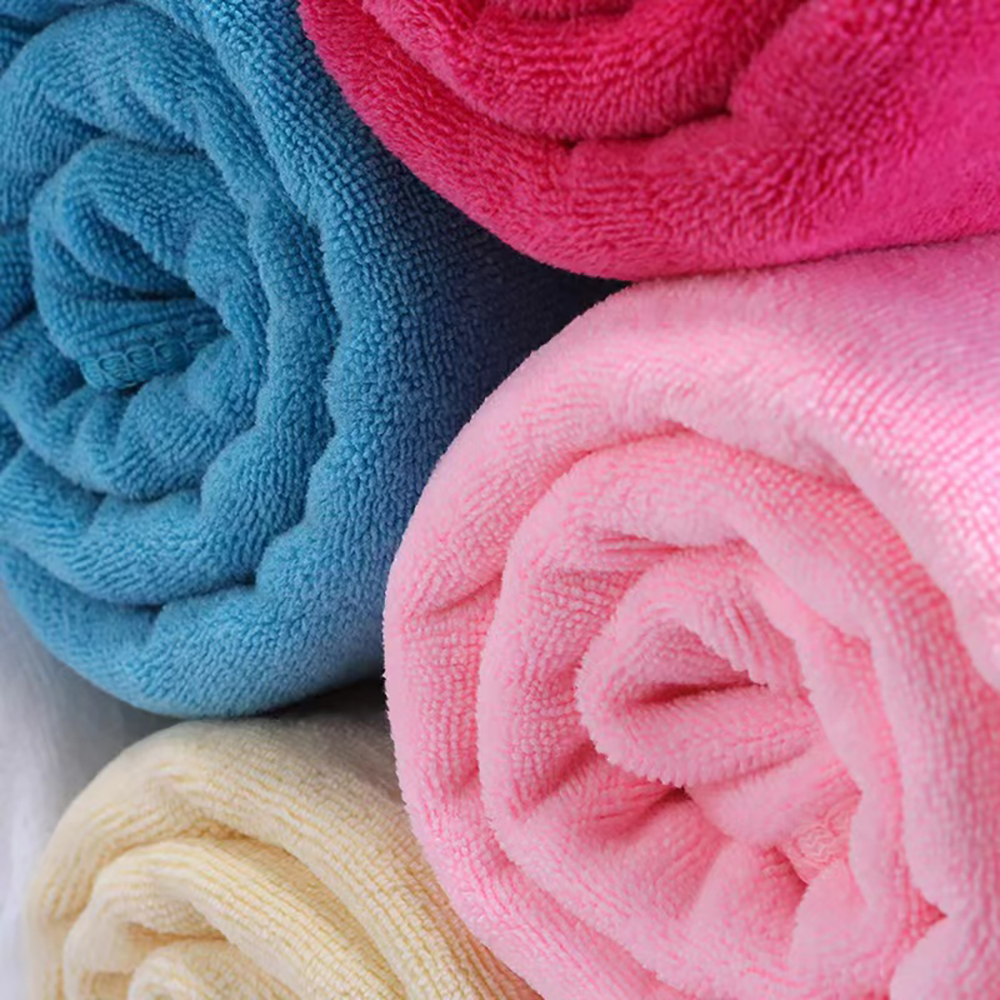
Weft-knitted brushed/brushed towels: This is currently one of the most popular categories. The woven fabric is abraded using a napping machine, breaking the surface loops into even, fine, and smooth short fibers. Towels treated this way have a smooth, peach-skin-like feel (also known as peach-skin velvet) and completely eliminate the snagging problem of traditional terry towels.
Heterogeneous Double-Sided Structure: Addressing the pain points of traditional microfiber towels—such as a “plastic feel” and difficulty in wringing dry—the new heterogeneous weft-knitted towel features a double-sided design. One side is a microfiber sheared side, responsible for efficient water absorption and stain removal, with a smooth feel; the other side is a cotton or regenerated cellulose fiber loop side, responsible for improving skin-friendliness and better aligning with people’s preferred “dry and wring-dry” experience.
Application Scenarios: Beyond Just Wiping Your Face
Thanks to the above characteristics, microfiber weft-knitted towels have long since transcended the traditional household use:
Car Detailing and Precision Cleaning: High-gram-weight weft-knitted towels (430GSM or even 500GSM) are standard equipment in car washes. Its thick, absorbent, and lint-free properties ensure that it won’t leave annoying lint when wiping glass or car paint.
High-end hair and personal care: Due to its dense fibers, it quickly dries hair without damaging the cuticles through friction. Many salon-grade towels use a 70% polyester + 30% nylon formula.
Digital printing customization: The smooth surface of the sheared weft-knitted towel is ideal for digital heat transfer printing. Clear patterns, saturated colors, and reduced wastewater discharge make it a popular choice for personalized gift towels.
How to choose and care for it?
Check the weight (GSM): The higher the GSM, the thicker and more absorbent the towel. For kitchen wiping or face washing, 300-400 GSM is suitable; for car washing or bath towels, 400 GSM or higher is recommended.
Feel the texture: A high-quality weft-knitted towel should have a delicate, velvety feel, not a smooth, plastic-like feel.
Washing Instructions: Although microfiber towels are durable and washable (lasting more than four times longer than cotton towels), their strong absorbency means they should not be washed with pure cotton fabrics to avoid lint buildup. It is best to use a neutral detergent and avoid using fabric softener (as it can clog fiber pores and reduce absorbency).
Summary: Microfiber weft-knitted towels are a perfect combination of materials science and weaving technology. They conquer the skin with ultimate softness, conquer oil stains with highly effective physical cleaning, and conquer humid environments with their quick-drying properties. In this era of pursuing health and efficiency, choosing a good weft-knitted microfiber towel means choosing a cleaner and more comfortable lifestyle.
Post time: Jun-11-2026