

The Dignity of a Cloth: How to Choose the Right Drying Towel to Protect Your Car’s Paint
Have you ever experienced this scenario? After sweating it out at a self-service car wash or meticulously wiping down your car in your own driveway, you step back to admire the results in the sunlight—only to discover countless fine, radial “swirl marks” (or “spiderwebs”) and even tiny scratches on the paintwork. That sinking feeling in your heart is akin to realizing your wallet has been slashed.
Where did things go wrong? The culprit is likely the drying towel in your hand—an item that seems harmless enough.
In the world of car detailing, a cloth is far more than just a piece of fabric. It is the final line of defense in direct contact with your car’s paintwork, and it determines whether the washing process enhances your car’s appearance or damages it. Today, we won’t discuss engine specs or interior technology; instead, we’ll focus on the drying towel—an essential tool for maintaining your car’s “complexion.”
Common Misconceptions: Why Cotton Towels and Old T-Shirts Are “Silent Killers”
Many people habitually use household cotton towels or even discarded T-shirts to dry their cars, believing that because these items are soft and absorbent, they are a practical choice. This is one of the most widespread misconceptions.
First, there is the issue of trapped dirt. Cotton fibers are relatively coarse and have a loose structure, making it easy for them to retain tiny particles of grit and dust even after washing. When you wipe the car body, these “invisible abrasives”—driven by pressure and friction—act like sandpaper, leaving marks on your car’s clear coat.
Second, there is the annoyance of lint. Cotton fibers break and shed easily; after drying the car, a layer of fine lint is often left behind on the paint. This is particularly unsightly on dark-colored cars, significantly detracting from the quality of the wash.
Finally, there are limitations regarding absorbency and flexibility. Cotton towels become heavy when saturated and lack the flexibility to conform closely to the curves of the car body. This results in lower drying efficiency and a higher risk of uneven friction.
Professional tasks require professional tools—and that includes the right cloth. Choosing the Right Material: The “High-Tech” World of Microfiber
Microfiber towels are the standard choice in automotive detailing today. However, not all are alike; you need to select the right “formula” based on the specific task and requirements.
Long-Pile Microfiber (commonly known as “Chenille” or “Coral Fleece”) — The King of Pre-Wash Absorption
Appearance and Feel: Long pile; feels fluffy and soft, like a cloud.
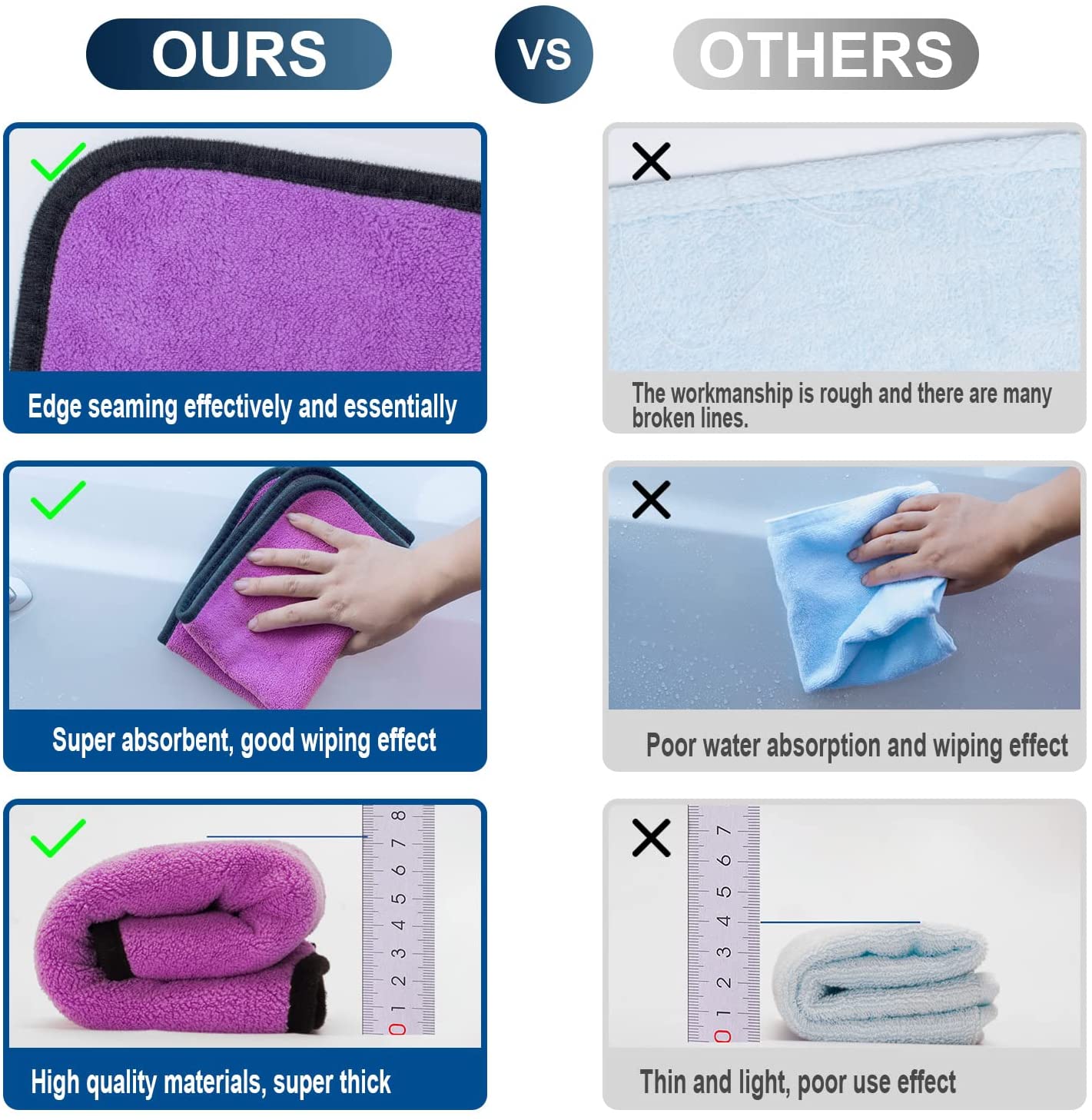
Core Task: Pre-wash and water absorption. After using a high-pressure washer to remove heavy dirt and grit, use this towel with car wash soap; the long fibers reach deep into crevices to “encapsulate” and lift away remaining fine particles, significantly reducing the risk of scratches. It is also highly efficient for drying the vehicle, as its high absorbency allows it to quickly soak up the bulk of the water.
Note: Not recommended for removing wax or paint sealants, as it tends to “greedily” absorb too much product, leading to waste.
Short-Pile Microfiber (commonly known as “Woven” or “Flat-Weave” Cloth) — The Expert in Polishing and Wax Removal
Appearance and Feel: Extremely short pile and tight weave; feels smooth yet firm.
Core Task: Removing wax and sealants, and mirror-finish polishing. Its short-pile structure provides superior “cutting power” and polishing capabilities. When removing cured wax or sealant, it offers the right amount of friction to easily lift away residue, while its flat surface “smooths out” the wax layer to reveal a deep, mirror-like shine. It is also an ideal choice for cleaning glass, as it rarely leaves water streaks.
Hybrid-Weave Microfiber (e.g., “Waffle Weave” or “Honeycomb Pattern”) — The Versatile, Streak-Free Cleaner
Appearance and Feel: Features a three-dimensional grid or honeycomb texture.
Core Task: Streak-free cleaning. Its unique woven structure creates countless tiny “scrapers” that effectively remove oily films and stubborn stains, while the recessed areas of the mesh “trap” the dislodged grime, preventing it from dragging across the paintwork. It is ideal for removing tar and bug residue, cleaning wheels, or serving as a final wipe-down cloth after glass polishing.
Usage and Care: Keeping Your “Battle-Tested Ally” Like New
You’ve invested in a high-quality car towel, but improper care can cause its performance to deteriorate rapidly.
Designate Specific Towels for Specific Tasks: Have at least 3–4 towels for different purposes and distinguish them by color. For example: blue for glass, yellow for drying the bodywork, green for wax removal, and red for wheels and stubborn stains. Never mix them up.
Gentle Washing: Use a pH-neutral car wash soap or a dedicated microfiber detergent. Avoid standard laundry powders or liquids containing bleach, fabric softeners, or strong alkaline ingredients. Fabric softeners can clog the gaps between fibers, compromising their absorbency and dirt-trapping capabilities.
Low-Heat or Air Drying: If using a dryer, always select the low-heat setting. High temperatures can melt the tips of the microfiber strands, causing them to harden and curl, thereby destroying their signature softness and cleaning efficiency.
Wash Separately: Do not wash with garments featuring zippers or Velcro; these can snag and completely ruin your towel.
Conclusion
The next time you prepare to wash your car, take a moment to really look at the cloth in your hand. It may not command attention like high-performance tires or stylish rims, but day after day, it meticulously protects your car’s paintwork and shapes your mood after every wash. Choose the right towel and care for it properly; you will find that the reward is your car’s flawless, mirror-like, and deep luster. This kind of pure beauty is precisely what makes car care such a captivating ritual.
Post time: Jul-24-2026